
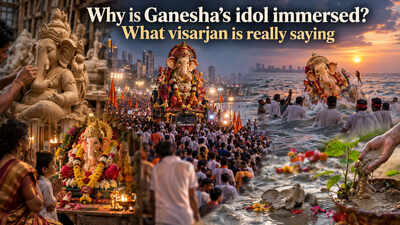
On the night of Anant Chaturdashi, the sand at Mumbai’s Girgaon Chowpatty vanishes underfoot. A truck carrying a twenty-foot Ganesha, built over four months in a Lalbaug workshop, edges toward the water while a few hundred men wade in beside it, chanting a name they’ll shout again next August. Within the hour, a figure that took a season to build will be silt.Nobody tries to pull him back out. The crowd built this idol knowing how the night would end, and they came anyway. Some are crying. Most are already talking about next year’s murtikar, the craftsman who will start again with a lump of clay.
A Goodbye That Happens Before the Water Does
Most people watching assume the immersion itself is the farewell. It isn’t.Before the idol is lifted and carried to the water, priests perform the uttarapuja, a closing worship that formally releases the deity from the murti, chanting the visarjan mantra, something close to: “Gachha gachha surashreshtha, swasthane Parameshwara” — go, go, best among the gods; return to your own abode.Only after that request is made does anyone move the idol.By the ritual’s own logic, the murti going into the water isn’t inhabited anymore. Ganesha has already left. What the crowd carries to Chowpatty is the vessel, not the guest. That is how a festival built on welcoming a god into clay can end with that clay being broken apart in public without the act reading as loss.
Why the Body Was Always Going to Come Apart
Traditional idols are shaped from shadu mitti, a fine river clay that was never meant to survive water for long. It was cheap, local, and dissolved cleanly — qualities that mattered to the craftsmen who built this custom more than permanence did.The Taittiriya Upanishad, in its Brahmananda Valli section, describes the elements — space, air, fire, water, and earth — emerging in sequence from Brahman. These five, the panchabhuta, are also understood as the material from which every body is temporarily arranged and to which it will eventually return.A clay Ganesha runs that same arc on a ten-day clock instead of a lifetime. He starts as riverbank earth, is dressed and garlanded and treated as present for the festival, then goes back into the water from which he was made.The dissolving isn’t an accident of poor materials. It is the material doing what it was chosen to do.
The Shape Was Only Ever a Loan
There’s a reason none of this reads as tragic to the people performing it.Advaita Vedanta, the school associated with Adi Shankaracharya, distinguishes between nirguna Brahman, the formless absolute, and saguna Brahman, that same reality given a form a worshipper can address.A murti belongs to the second category: a form lent to devotion, not a container the divine was ever fully confined within. Once the worship ends, the loan comes due, and the clay is free to become clay again.
Ten Days — or One, Depending on the Household
Not every home keeps Ganesha for the full ten days. Some idols go back the next morning, on what’s called Dedh Divas, a day and a half. Others stay for three, five, or seven days before a private visarjan, often in nothing grander than a bucket in the courtyard.In 2026, Anant Chaturdashi, when the largest public pandals immerse together, falls on Friday, September 25.A household saying goodbye on day three is keeping its own timeline for the same farewell.
The Clay Problem Nobody Wants to Dwell On
Here’s the part that complicates the poetry.Plaster of Paris idols, painted in synthetic colours, don’t dissolve the way shadu mitti does. They can remain in lakes and rivers for months, while paints and other materials may contribute pollutants to the water. The Central Pollution Control Board’s guidelines push cities toward clay idols and artificial immersion tanks, but enforcement is patchy.What’s actually spreading is a quieter alternative: households switching back to shadu clay and immersing smaller idols at home, in a bucket, instead of taking them to the sea.
A Festival That Outgrew a Single Home
The scale at Chowpatty — the drumming, the processions stretching for hours before a single idol touches water — traces in part to 1893, when Bal Gangadhar Tilak turned a largely private household ritual into a ten-day public festival open to everyone, regardless of caste. Under British rule, the public celebration also provided Indians with a legal pretext to assemble in large numbers.That history helps explain why Maharashtra’s visarjan still looks like public theatre, while a Ganesha in Chennai or Bengaluru might leave a home almost unnoticed.The chant that carries through both — “Ganpati Bappa Morya, pudhchya varshi lavkar ya” — “Ganpati Bappa Morya, come again soon next year” — is traditionally associated with Morya Gosavi, a devotee who settled in Chinchwad near Pune and whose name became fused with the invocation.Back at the water’s edge past midnight, when the drumming has mostly stopped, a woman wades in only up to her knees, holding a Ganesha barely a foot tall. She says something to it that nobody else catches, sets it down, and turns back toward the sand.At home the next morning, some families do something smaller still: they scoop the settled clay from their own bucket and tip it straight into a garden pot or at the base of a tulsi plant, so the earth that was briefly a god goes on holding something green.


