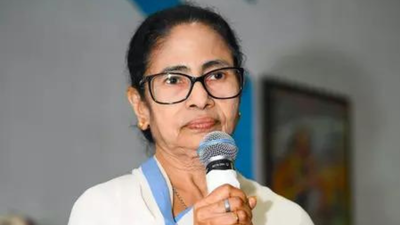
NEW DELHI: A day after the BJP’s sweeping victory in West Bengal, Trinamool Congress chief Mamata Banerjee on Tuesday refused to accept the verdict as a reflection of public mandate. Mamata declared that she will not be resigning, alleging irregularities and signalling a multi-pronged political and legal response.“I will not resign, I did not lose, I will not go to Raj Bhavan…The question doesn’t arise. No. Now, I also want to say that we didn’t lose the election. It is their attempt to defeat us. Officially, through the Election Commission, they can defeat us, but morally we won the election.” Mamata Banerjee said, addressing a press conference in Kolkata.
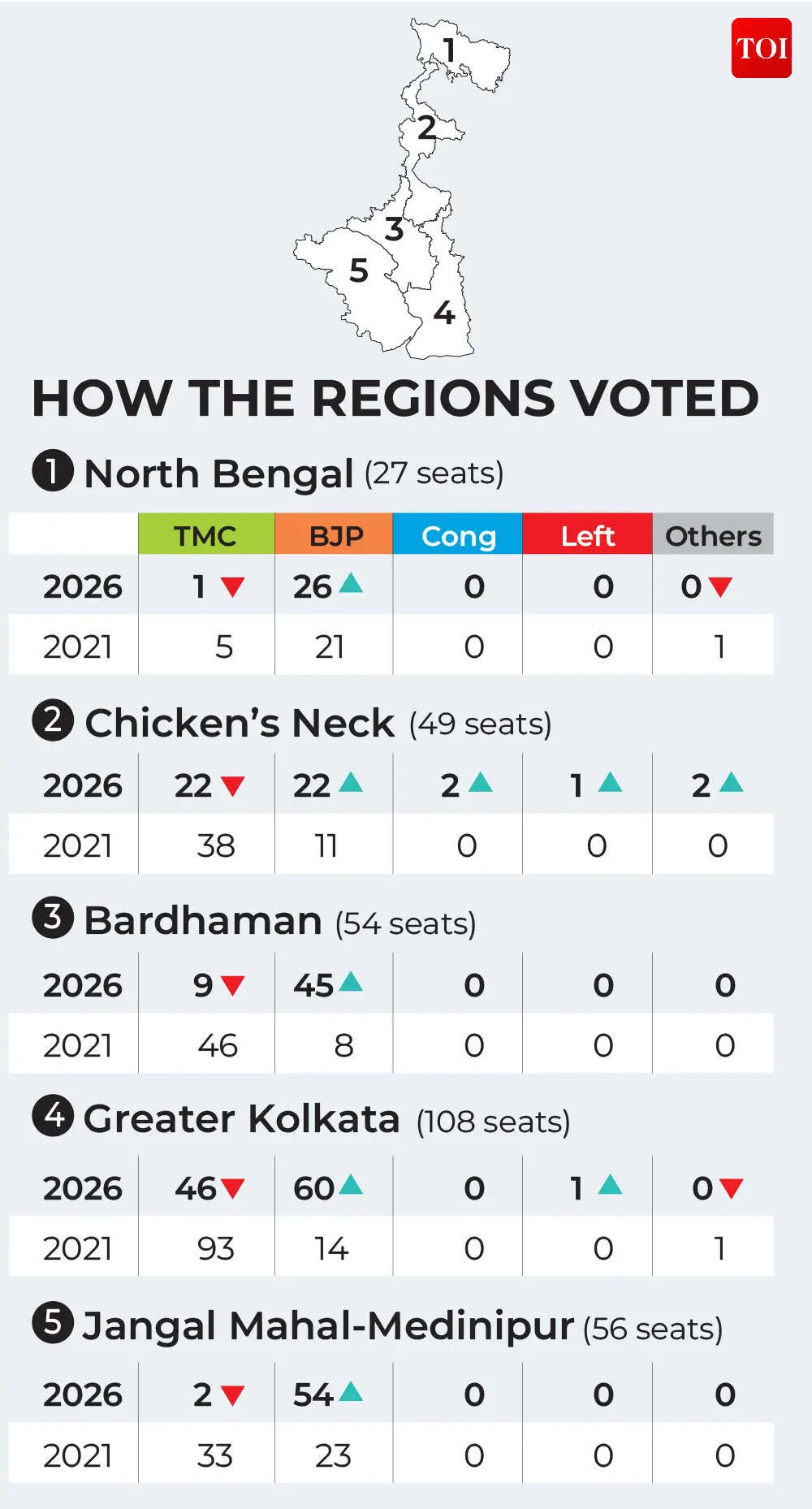
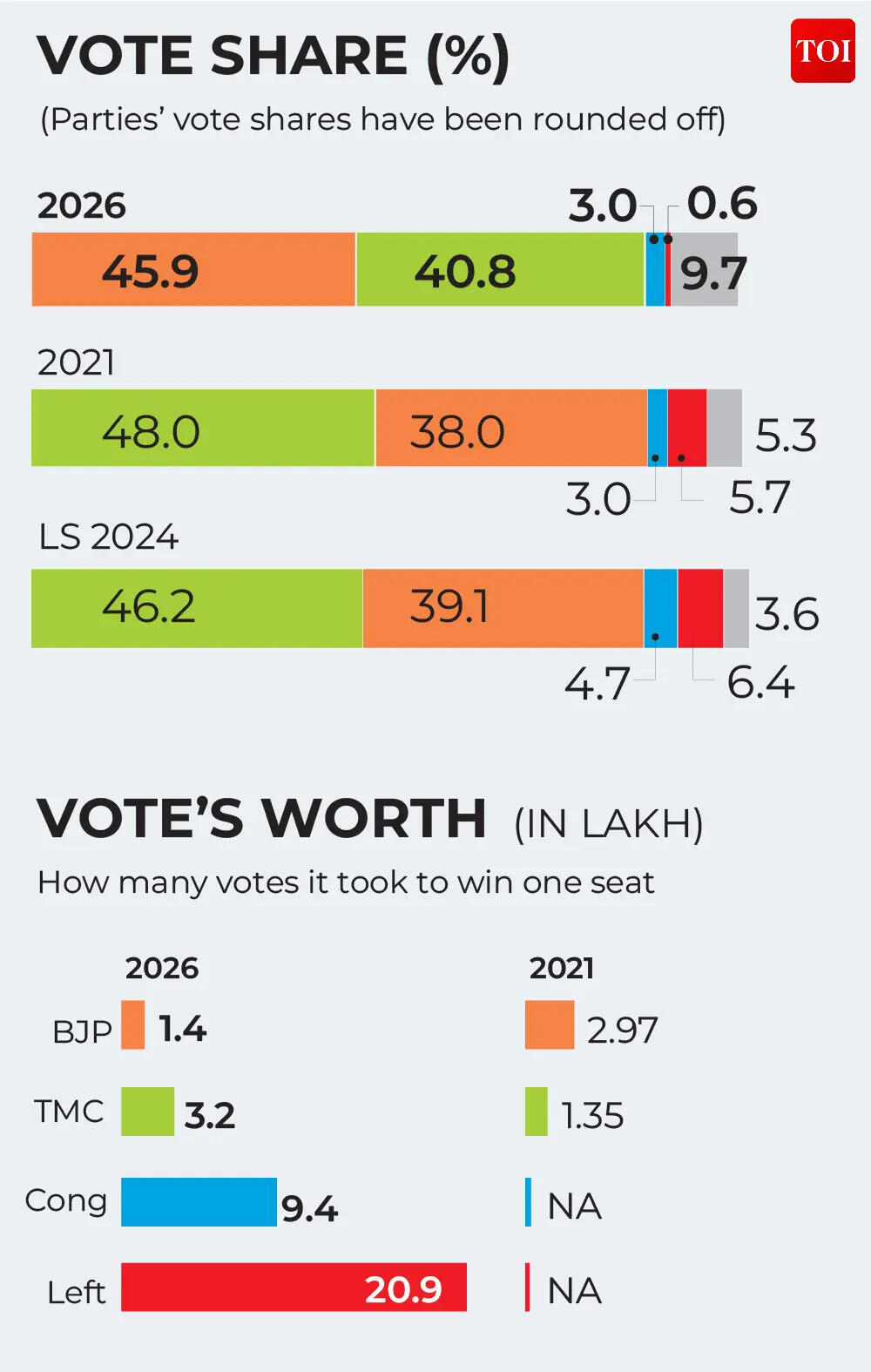
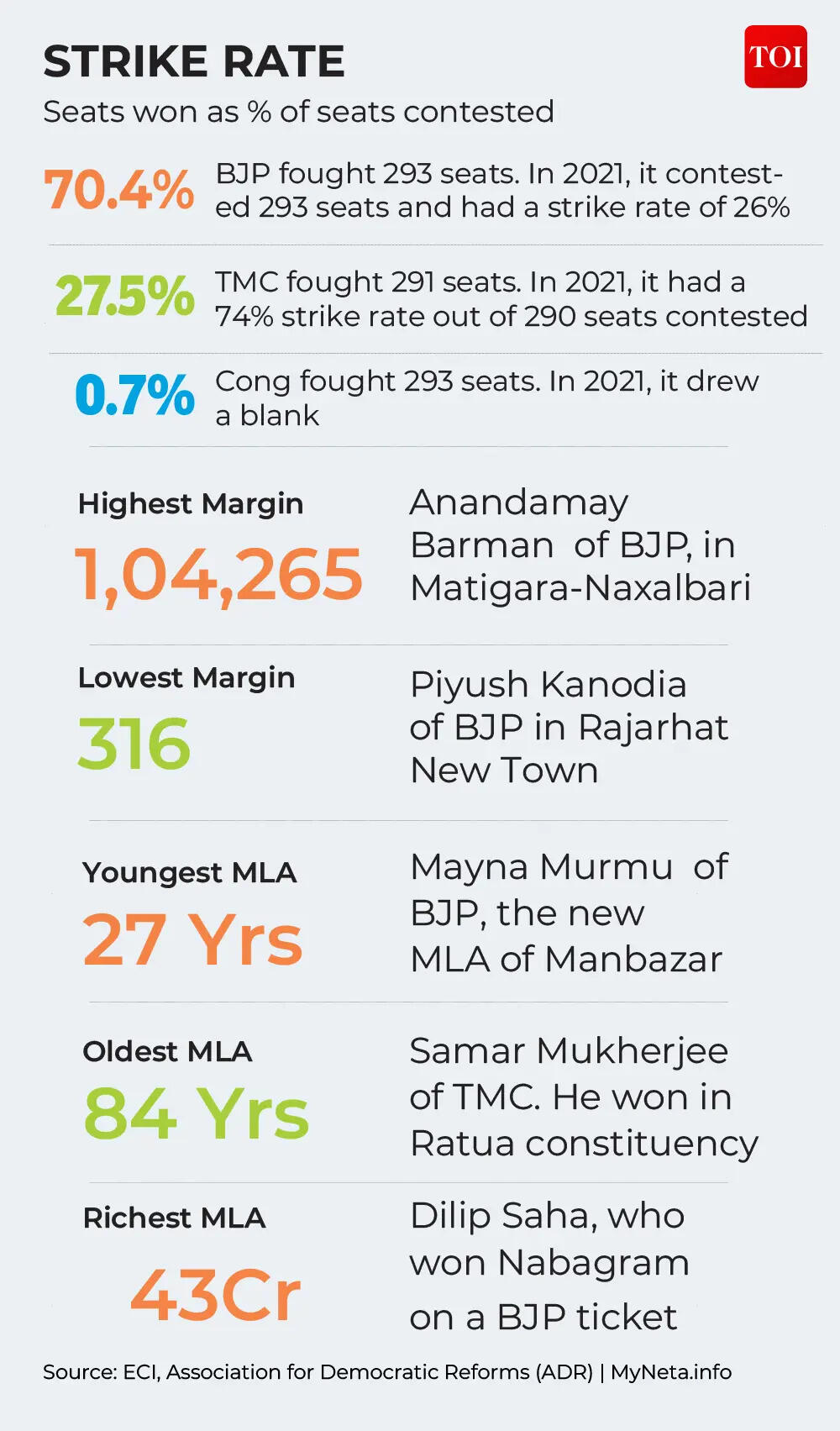
Escalating her attack, she said, “We did not fight BJP, we fought EC which worked for the saffron party,”.Adding weight to the sentiment, TMC MP Kalyan Banerjee said “For the last 3 months, Model Code of Conduct is in place. Who is running the Govt? Chief Secretary. So, for the last 3 months, she had not been working as the CM. So, what is the question of resignation?…”The TMC chief also announced that the party will set up a 10-member fact-finding committee to visit areas affected by post-poll violence across the state.The statements come even as the BJP tightened its grip on the assembly, taking its tally to 207 seats in the 294-member House after a recount victory in Rajarhat-New Town. The result followed Monday’s decisive mandate, which saw the BJP cross the two-thirds mark and end the TMC’s 15-year rule in the state.
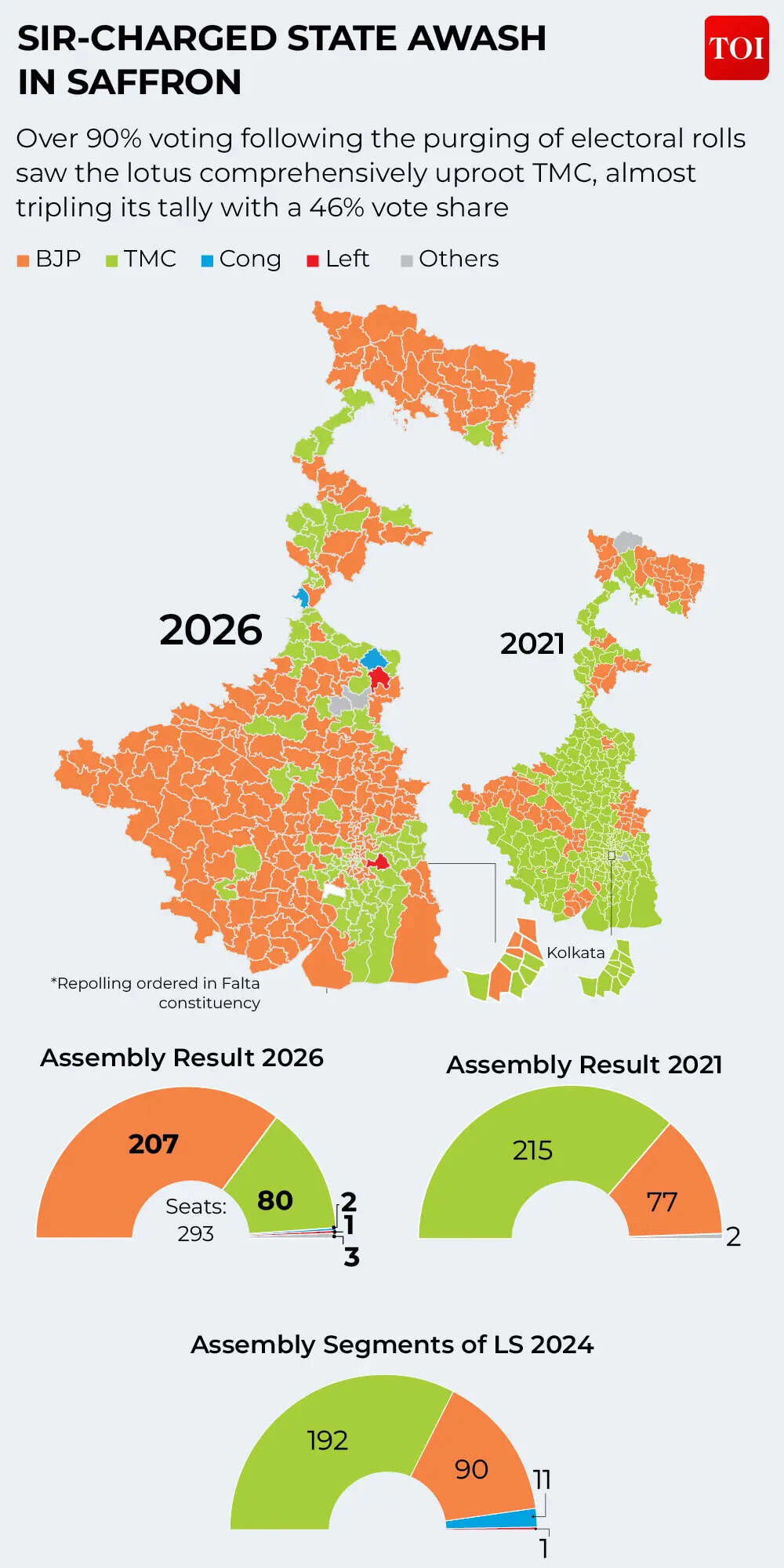
With the current assembly term ending on May 6, attention has now shifted to government formation. According to reports, the oath-taking ceremony is likely on May 9, coinciding with Rabindranath Tagore’s birth anniversary, though an official announcement is awaited.
What happens next?
As per procedure, Mamata Banerjee is expected to resign as chief minister but continue in a caretaker capacity until the new government is sworn in. The BJP, as the majority party, will then stake claim to form the government, following which the governor will invite its leader to take oath.
Even as the transition process begins, the TMC may pursue multiple options in response to the electoral outcome. However, Mamata Banerjee may find it difficult to sustain her stance of not stepping down as chief minister.TMC may explore legal options including election petitions in the culcutta high court.There is also discussion around broader political mobilisation on the ground and the possibility of coordinated action with INDIA bloc allies.
“Sonia ji, Rahul Gandhi, Arvind Kejriwal, Uddhav Thackeray, Akhilesh Yadav, Tejashwi Yadav, Hemant Soren rang me up. All the allies of INDIA Alliance told me that they are totally and absolutely with me. I think our solidarity will be united and strong for the next days. Akhilesh requested me if he can come today itself but I told him to come tomorrow. So, he will come tomorrow.” TMC Supremo Mamata Banerjee said.“One by one everyone will come. My target is very clear. I will strengthen the INDIA team, just like a small person. I don’t have any chair now, so I am a commoner. So, you cannot tell me that I am using your chair. I am now a free bird. I gave my entire life in service to the people, even in these 15 years I have not withdrawn one paisa of pension. I am not taking one paisa of salary also. But now, I am a free bird. So, I have to do some work, that I will manage to do.” She added.
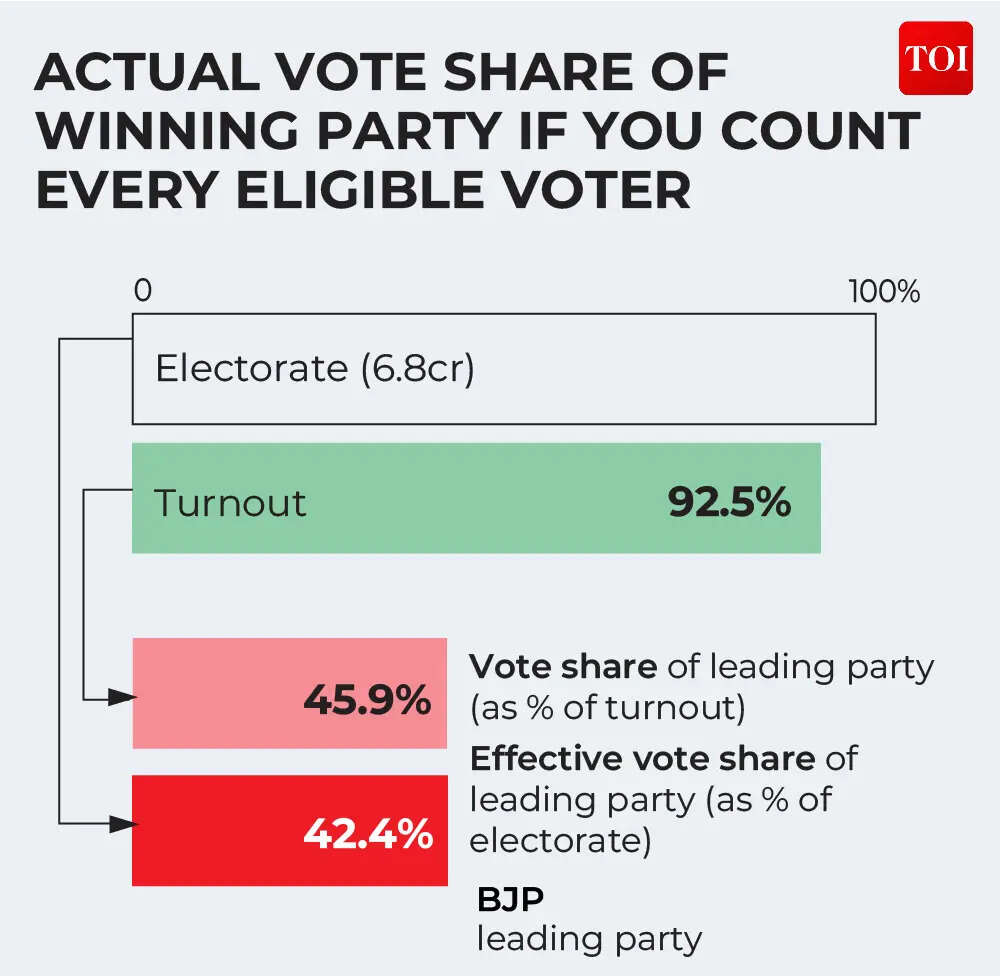
A collective petition in the Supreme Court challenging aspects of the SIR process, including voter roll revisions, could also be considered.“We fought against the entire machinery, with the Prime Minister and the Home Minister also involved, there was direct interference. They deleted 90 lakh names from the voter list. When we approached the court, 32 lakh names were restored. But do you know that another seven lakh names, which were submitted together, were also included later, and nobody is aware of that? This shows how such dirty, nasty, and mischievous games were played,” Mamata said, highlighting concerns around the SIR process.
The legal angle
But how far can TMC’s legal strategy realistically travel? Swapnil Tripathi, who heads Charkha, the Centre for Constitutional Law at the Vidhi Centre for Legal Policy, answered TOI questions.On whether Mamata can hold on to office without resigning –echoing what Delhi CM Arvind Kejriwal did– Tripathi was equally clear that the Constitution leaves little room for manoeuvre. “In our constitutional scheme, a Chief Minister holds office under Article 164 at the pleasure of the Governor, but that ‘pleasure’ is not personal — it is tied to whether the Chief Minister commands the confidence of the Legislative Assembly. Once elections conclude and the term of the Assembly comes to an end, a new House is constituted, and with it, the locus of confidence shifts to the newly elected representatives,” he said.
Tripathi noted that there is a well-established constitutional convention that the outgoing Chief Minister resigns and continues briefly as a caretaker until the new government is sworn in. “If that convention is not followed, it does not alter the legal position. The Governor can simply withdraw pleasure and invite the leader who commands majority support in the new Assembly. So, refusal to resign is more a matter of politics than law — the Constitution ensures that a Chief Minister who no longer has majority support cannot continue in office. The election ends the mandate; resignation merely recognises it,” he said.TOI query on the scope of election petitions to challenge alleged voter list manipulation, Tripathi cautioned that the framework has built-in limitations. “The difficulty with allegations of voter list manipulation is that they are typically directed against the Election Commission, but in an election petition under the Representation of the People Act, 1951, the Election Commission is not a proper party. The statute is designed to challenge the election of a candidate, not the conduct of the Commission in the abstract,” he told TOI.He added that an election petition has to be framed against a returned candidate, and the petitioner must show that the result was materially affected by a violation of electoral law. “A general allegation against the Election Commission, without linking it to a candidate’s election, falls outside that framework. This reflects a deeper structural feature of Indian election law — it is individualised and constituency-specific. You cannot mount a broad, systemic challenge to the electoral roll or its preparation through a single election petition. So, if the grievance is really against the preparation of voter lists by the Election Commission, the more appropriate remedy would lie in constitutional proceedings, not in an election petition,” Tripathi said.On the possibility of a fresh Supreme Court challenge to the Special Intensive Revision process — particularly if statistical correlation is shown between voter deletions and winning margins — Tripathi said such a petition is maintainable, but the bar is high. “Yes, the Special Intensive Revision process can certainly be challenged before the Supreme Court under Article 32, particularly if it is argued that it violates constitutional guarantees such as equality under Article 14, the prohibition on exclusion from electoral rolls on grounds only of religion, race, caste or sex under Article 325, or the framework of universal adult suffrage under Article 326,” he told in a text interaction with TOI.However, he warned that a statistical correlation alone may not be enough. “Courts will look for more than correlation — they will require clear evidence of illegality, arbitrariness, or procedural unfairness in the process itself. That said, the Election Commission enjoys wide constitutional discretion under Article 324 in the conduct of elections, and the scope of judicial review in such matters is relatively limited. So, while a fresh constitutional challenge is entirely maintainable, the burden of proof would be high,” Tripathi said.


