
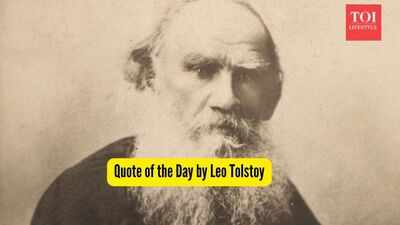
Few writers have explored the human heart with the intensity, honesty and philosophical depth of Leo Tolstoy. His novels were vast in scale, filled with wars, families, marriages, social upheaval and political change, yet at their centre were deeply personal questions. Born into Russian aristocracy, Tolstoy grew up surrounded by privilege, but spent much of his life questioning the very values of the society into which he had been born. He became one of the greatest novelists in world literature, but his influence extended far beyond fiction. His ideas on non-violence, morality, simplicity and resistance to injustice influenced thinkers and political leaders across the world, most famously Mahatma Gandhi.From aristocratic beginnings to literary greatnessLeo Tolstoy was born on September 9, 1828, at Yasnaya Polyana, his family’s estate south of Moscow. He belonged to an old Russian aristocratic family and inherited the privileges associated with that social position. But Tolstoy’s childhood was marked by loss. His mother died when he was very young, followed by his father a few years later. He was raised largely by relatives and servants alongside his siblings.As a young man, Tolstoy entered Kazan University but did not complete his studies. He returned to his family’s estate and struggled to find direction. He experimented with different ways of living and began keeping the diaries that would remain an important part of his life.His early years were filled with contradictions. He enjoyed the privileges of an aristocrat while simultaneously becoming increasingly uncomfortable with the emptiness he saw in his own life. That tension would become one of the defining themes of his writing.The soldier who became a writerTolstoy’s life took another turn when he joined the Russian army. His experiences during military service exposed him to violence, death and the realities of war. He served in the Caucasus and later during the Crimean War. These experiences became important material for his early fiction. His first major literary success came with Childhood, published in 1852. It was followed by Boyhood and Youth, completing a semi-autobiographical trilogy. Tolstoy quickly established himself as a major new voice in Russian literature.His writing was different from conventional romantic fiction. He was intensely interested in ordinary human behaviour-the small gestures, private doubts, selfish impulses, jealousies, disappointments and moments of tenderness that shape people’s lives. He did not simply want to tell readers what his characters did. He wanted them to understand why they did it.‘War and Peace’: A world in one novelTolstoy’s greatest achievement, War and Peace, was published in book form in the late 1860s. The novel is enormous in both size and ambition. Set during the Napoleonic Wars, it follows aristocratic families and individuals whose lives become entangled with the upheavals of history. Yet calling it simply a “war novel” would be misleading. Tolstoy combines romance, family drama, philosophy, politics and history. He moves between the battlefield and the drawing room, between soldiers and aristocrats, between private decisions and events involving entire nations. One of the novel’s most important ideas is that history is not shaped solely by supposedly great men. Tolstoy questioned the idea that figures such as Napoleon single-handedly create history. Instead, he suggested that millions of individual actions, circumstances and social forces combine to produce historical change.This was revolutionary in its scope. Tolstoy was interested in the relationship between individual freedom and forces beyond human control, a question that would continue to occupy him throughout his life.‘Anna Karenina’ and the complexity of loveTolstoy followed War and Peace with another masterpiece, Anna Karenina, first published as a serial in the 1870s. The novel begins with marriage, desire and social expectations but gradually becomes a profound examination of human relationships. Anna’s story explores passion, jealousy, social judgement and the devastating consequences of seeking fulfilment outside the boundaries imposed by society. Alongside Anna’s story is the quieter journey of Konstantin Levin, whose struggles with work, faith, family and the meaning of existence closely reflected Tolstoy’s own philosophical concerns.One of Tolstoy’s greatest strengths was his refusal to divide people neatly into heroes and villains. His characters are contradictory because human beings themselves are contradictory. People can be generous and selfish, loving and cruel, courageous and frightened, all within the same life.The spiritual crisis that changed TolstoyDespite his extraordinary literary success, Tolstoy experienced a profound spiritual and existential crisis in middle age. He had fame, wealth, family and intellectual achievement, yet he became increasingly troubled by a fundamental question: What is the meaning of life if everyone eventually dies?His crisis led him to rethink almost everything he had previously accepted. He began rejecting materialism, excessive wealth and social privilege. He became increasingly critical of organised religion, the state, violence and institutions that he believed encouraged inequality and suffering. His transformation did not happen overnight. It was an intense, lifelong struggle. In A Confession, Tolstoy described this period of spiritual questioning. He increasingly came to believe that a meaningful life required compassion, moral responsibility, simplicity and love for others.Tolstoy’s philosophy of non-violenceTolstoy’s later writings became increasingly philosophical and political. He argued that violence could not ultimately create a moral society. Instead, he advocated resistance to evil through non-violence and moral courage. His ideas attracted readers around the world. Among them was Gandhi, who corresponded with Tolstoy and was deeply influenced by his writings on non-violence and moral resistance. Their exchange helped strengthen ideas that would later become central to Gandhi’s philosophy and political practice.Tolstoy’s influence was therefore not confined to literature. His ideas entered debates about pacifism, social justice, religion, political authority and ethical living.A writer who questioned his own privilegePerhaps one of the most remarkable things about Tolstoy was that he did not spare himself from the criticism he directed at society. He belonged to the privileged class he increasingly questioned. He owned a large estate and had servants, wealth and social status, yet he became increasingly uncomfortable with this way of life. He attempted to simplify his existence and became interested in manual labour. This contradiction remained unresolved.His contribution to literatureTolstoy transformed the possibilities of the novel. His greatest contribution was perhaps his extraordinary understanding of human psychology. His characters do not merely perform actions; readers experience their thoughts, doubts, rationalisations and emotional conflicts. He also changed the way writers could portray history. Instead of presenting historical events as the actions of a handful of powerful individuals, he examined the countless human decisions and social circumstances behind them. His influence can be seen across world literature, from psychological fiction to historical novels and family dramas. More than a century after his death, War and Peace and Anna Karenina remain among the most widely read works of literature.But Tolstoy’s influence is not limited to his books. His essays, letters, diaries and philosophical writings continue to be studied because they reveal a mind constantly examining its own beliefs. Tolstoy’s later life became increasingly complicated. His radical ideas created tension within his family, particularly with his wife, Sophia Tolstaya, with whom he had a long and difficult marriage. In his final years, Tolstoy became increasingly determined to abandon the privileges and possessions that conflicted with his ideals. In 1910, at the age of 82, he secretly left his home, hoping to begin a simpler life away from the conflicts surrounding him. During the journey, he became seriously ill. He died on November 20, 1910, at the railway station of Astapovo. His death became an international event, reflecting the extraordinary stature he had achieved.Quote of the day“When you love someone, you love the person as they are, and not as you’d like them to be.”This quote captures one of the most difficult truths about love: real love is not the same as loving an ideal version of someone. It is easy to love people when they behave exactly as we want them to. The challenge begins when we discover their flaws, their habits that irritate us, their weaknesses, their fears, their mistakes and the parts of their personality we wish were different.Tolstoy’s idea suggests that love cannot be built entirely around expectations. If we love someone only because we hope they will change, we may not actually be loving the person—we may be loving a version of them that exists primarily in our imagination.To love someone “as they are” does not mean accepting everything they do without question. Love does not require tolerating cruelty, disrespect or harmful behaviour. Rather, it means recognising the difference between loving a person and trying to redesign them.There is an important distinction between acceptance and approval.You can wish someone would grow while still accepting who they are today. You can disagree with them without denying their humanity. You can see their flaws clearly and still recognise their worth. That may be why the idea remains so powerful.


