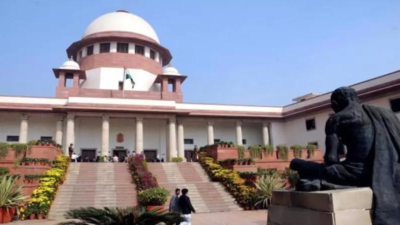
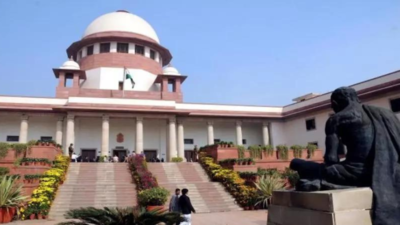
NEW DELHI: The Supreme Court on Wednesday refused to adjourn hearings on petitions challenging the constitutional validity of the 2023 law on the appointment of election commissioners, making it clear that the issue was “more important than any other matter”.A bench of Justices Dipankar Datta and Satish Chandra Sharma turned down a request from Solicitor General Tushar Mehta, who sought an adjournment citing his engagement before a nine-judge Constitution bench dealing with matters related to religious freedom, including the Sabarimala Temple issue.Refusing the plea, Justice Datta highlighted the weight of the matter, stating, “This matter is more important than any other matter.” He further remarked on the prioritisation of cases, saying, “We read in the newspapers that there is an observation that the PIL in Sabarimala should not have been entertained by the court. So, with due respect to the judges, nine judges are occupied in a matter where there is an observation that it should not have been entertained in the first place.”The bench allowed the petitioners to commence arguments and directed them to wrap up submissions by Thursday, indicating that the Centre would be heard subsequently.At the heart of the proceedings is the Chief Election Commissioner and Other Election Commissioners (Appointment, Conditions of Service and Term of Office) Act, 2023. The law altered the composition of the selection committee by removing the Chief Justice of India and replacing the position with a union minister nominated by the Prime Minister.During the hearing, the Supreme Court also raised a fundamental constitutional question, whether it can direct Parliament to enact a law governing the appointment of the Chief Election Commissioner (CEC) and Election Commissioners.Justice Dipankar Datta pointed to one of the prayers in the petitions seeking such a direction and questioned its maintainability. “Come back to the prayers… it has asked Parliament to make a law. Can the court ask Parliament to make a law? Could this be maintainable,” he asked.The bench examined this issue in the context of its March 2, 2023 ruling in the Anoop Baranwal case, where a Constitution bench had prescribed a three-member selection committee comprising the Prime Minister, the Leader of Opposition, and the Chief Justice of India as an interim mechanism.Justice Datta emphasised that the ruling was intended as a temporary arrangement to address a legislative vacuum. “Why did the court then restrict the Anoop Baranwal judgement only till a particular period till the law is made? It was only to deal with a particular situation of a vacuum,” he observed.He further questioned whether the court’s detailed observations in that judgment could be treated as binding on Parliament while framing a law. “Aren’t these observations over 300 pages a justification for what the court laid down for a short period till the law is made? Can you say that the law also has to follow those observations,” he said, adding that the judiciary cannot mandate Parliament to legislate in a specific manner.Opening arguments for the petitioners, senior advocate Vijay Hansaria argued that the 2023 law gives the executive undue dominance in the selection process. Referring to the composition of the panel, the Prime Minister, a Union minister, and the Leader of Opposition, he said the structure effectively creates a “2-1” majority for the government.He described this as granting the executive “primacy” and warned it could reduce the selection body to a “pocket board”, enabling the appointment of “the prime minister’s man”. Hansaria stressed that the government of the day has a direct stake in electoral outcomes and therefore cannot have exclusive control over appointments.Citing Constituent Assembly debates, he argued that there was a clear intent to ensure elections are conducted by an independent authority “taken out of the hands of the government of the day”.Responding to the bench’s suggestion that the 2023 ruling was only a stop-gap arrangement, Hansaria maintained that while Parliament is empowered to legislate, any such law must preserve institutional independence and cannot hand over effective control to the executive.The arguments also touched on public confidence in the Election Commission, with Hansaria referring to criticism faced by poll authorities in recent times.Countering this line of reasoning, Solicitor General Tushar Mehta said such arguments were flawed. “If there are abusive words against judges, should we remove the Collegium system? What kind of argument is this?” he asked.Senior advocate Gopal Sankaranarayanan, also appearing for the petitioners, argued that the principles laid down in the Baranwal judgment — particularly on limiting executive control — could not be overridden by an ordinary law and would require a constitutional amendment.The challenge stems from an earlier Constitution bench ruling in March 2023, which had laid down that appointments to the Election Commission would be made by a panel comprising the Prime Minister, the Leader of Opposition in the Lok Sabha, and the Chief Justice of India, an arrangement meant to operate until Parliament enacted a law.Petitioners, including Congress leader Jaya Thakur and the Association for Democratic Reforms, have argued that excluding the judiciary from the process undermines the independence of the Election Commission.Earlier, Chief Justice Surya Kant had recused himself from the case, observing, “I will be accused of conflict of interest. There is a conflict of interest.”The Centre, however, has defended the law, asserting that the autonomy of the Election Commission does not depend on the presence of a judicial member in the selection panel. It also rejected claims that the appointment of two election commissioners in March 2024 was rushed to pre-empt judicial scrutiny, noting that the process followed the provisions of the new law.The Supreme Court had earlier declined to stay those appointments, even as it agreed to examine the broader constitutional challenge to the 2023 legislation.The adjournment request by the Centre came in the backdrop of ongoing proceedings before a nine-judge Constitution bench led by Chief Justice Surya Kant, which is revisiting key questions around religious freedom, including the Sabarimala Temple issue.During the hearing on Tuesday, the bench made strong observations on the origins of the 2006 PIL that eventually led to the landmark Sabarimala verdict. It remarked that the court, at the time, ought to have “thrown in the dustbin” the petition filed by the All India Young Lawyers Association, noting that it was largely based on newspaper reports and lacked proper locus standi.The bench indicated that, at best, the court could have ordered a limited inquiry into alleged misconduct by temple authorities instead of entertaining a wider constitutional challenge. It also questioned the circumstances under which the plea was pursued, with Justice Nagarathna raising concerns over why individuals not adhering to the faith were questioning long-standing religious practices.Read more: Original Sabarimala PIL should’ve been binned, says Supreme Court


