
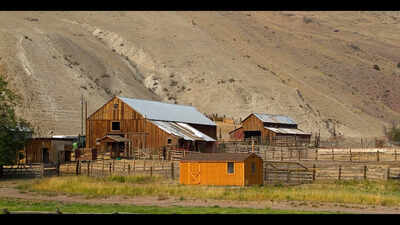
Tom Brokaw found an enduring connection to the natural world on a Montana ranch. In 1989, the then-NBC News anchor bought an interest in a roughly 4,000-acre property near the West Boulder River, seeking a place where he could escape the pace of broadcasting. What began as a private retreat became a long-term effort to manage land, restore habitat and observe how small changes affected wildlife.The Los Angeles Times confirmed in December 1989 that Brokaw had bought an interest in a 4,000-acre Montana ranch as a mountain retreat. The property was near the Absaroka-Beartooth Wilderness, an area known for mountain scenery and trout streams. Brokaw said at the time that he had been searching for property in Montana since visiting the state in 1981. The property eventually became known as the West Boulder Ranch. In a later interview with The Land Report, Brokaw explained that he had originally imagined buying only about 100 acres with a river. Instead, he and two partners acquired the much larger ranch. His wife Meredith eventually became equally attached to the property, and the couple later came to own it entirely.From retreat to restorationOwning a large ranch taught Brokaw that preserving a landscape was more complicated than simply leaving it alone. When he first became involved with the property, cattle had access to the river and grazed directly along its banks. Brokaw later recalled that he and his family began removing some fences and fencing off the riparian zone, allowing the vegetation beside the river to recover. They also tackled leafy spurge, an invasive plant that had become a problem on the ranch. Sheep and biological controls were among the approaches used to deal with it.Protecting the river corridor also affected habitat beyond the waterway. Riparian vegetation can provide food, shelter and nesting habitat for wildlife, while reducing livestock pressure can allow shrubs and grasses to recover. Research from Montana and elsewhere supports the broader ecological principle behind such work. According to a study published in Frontiers in Ecology and Evolution, increases in riparian vegetation, including woody plants, native grasses and forbs, were associated with greater bird diversity in mixed-grass prairie in north-central Montana. The researchers found that areas where this vegetation increased over time also showed increases in bird diversity, highlighting the importance of healthy riparian habitat for wildlife.When the birds returnedBrokaw’s observations became one of the most striking signs of the ranch’s transformation. Working with a neighbour, he developed a project to increase the area’s upland bird population by planting about two acres of milo near wetlands for additional food and allowing grasses to grow taller in some ravines. He later reported seeing more birds, including Hungarian partridge and sharp-tailed grouse. However, this was an observation rather than a controlled scientific finding, and no published experiment demonstrated that the riverbank restoration alone caused the increase. The change may instead have reflected a combination of habitat protection, greater food availability, taller vegetation and changes in grazing management. Montana guidance indicates that sharp-tailed grouse use grasslands mixed with shrubs and riparian vegetation, while ruffed grouse are associated with wooded areas near streams.

NBC anchor Tom Brokaw. Image Credits: Wikimedia Commons.
A different kind of celebrity landownerThe Land Report states that the Brokaw family owned West Boulder Ranch for nearly 30 years before selling the property on September 28, 2018. The 4,128-acre ranch, located at the base of Montana’s Absaroka Mountains and adjoining the Absaroka-Beartooth Wilderness, included about a mile of the West Boulder River and supported a wide range of wildlife, including elk, mule and white-tailed deer, antelope and Hungarian partridge. During the family’s ownership, the property became closely associated with Brokaw’s efforts to understand and manage the land as a working landscape. The sale, whose financial terms were not disclosed, brought an end to almost three decades of family ownership.Brokaw’s Montana experience became more than the purchase of a scenic retreat. Brokaw came to the ranch as an outsider drawn by its scenery, but soon took on the role of a land steward focused on the grass and the river. Brokaw’s story suggests that private ranches can become wildlife habitat when owners manage the river, vegetation and grazing as one ecosystem.


