
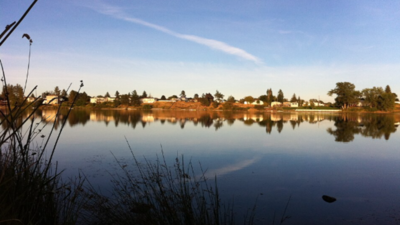
Long before it became a case study in lake restoration, Medical Lake in Spokane County, Washington, was known for its supposed healing properties. Native peoples and early settlers believed its mineral-rich water and mud could relieve ailments, and by the 1880s the shoreline hosted bathhouses, hotels, and a sanitarium catering to visitors seeking a cure. That reputation faded over the following decades as growing development and wastewater inputs pushed the lake into a state of chronic eutrophication. As a result, during the 1970s, thick algal mats and a foul smell in the lake made the water unusable for recreational purposes. The issue was later addressed through one of the country’s best-studied lake-restoration projects, which demonstrated the effectiveness of alum treatment in controlling phosphorus and algal blooms.Phosphorus in a lake’s nutrient cycleAt Medical Lake, phosphorus was the main problem, especially because much of it was recycled within the lake rather than entering from outside sources. The EPA report and National Academies summaries provide evidence that phosphorus-laden blue-green algal blooms continued in Medical Lake even after the redirection of wastewater, thanks to high levels of internal nutrient loading from enriched lake bottom sediments. Once phosphorus is absorbed into bottom sediments, it can return to the water through chemical reactions and fuel new algal blooms.Treatment in 1977What the researchers came up with was a whole-lake use of aluminium sulfate (alum). Over five weeks in August and September 1977, about 1,031 tons of liquid alum were applied to Medical Lake, disrupting the lake’s internal phosphorus cycle. When alum comes into contact with lake water, it forms a precipitate. The precipitate binds phosphorus in the water and forms a barrier that limits its release from the sediment below. The Washington State Department of Ecology documents the treatment in its statewide review of alum applications.
The restoration was documented in detail in a peer-reviewed paper by Raymond Soltero, Donald Nichols, and collaborators from Eastern Washington University and Battelle Pacific Northwest Laboratories. Because the title of that study runs long, it is cited here through its home journal instead: Lake Restoration: Medical Lake, Washington, appeared in the Journal of Freshwater Ecology in 1981. The study found that alum lowered phosphorus levels, reduced algal blooms, and improved water clarity. Application of alum lowered phosphorus concentrations, eliminated nuisance algal blooms, and improved water clarity during the years following treatment.Return of life to the lakeThe chemical treatment cleared up the waters of Medical Lake and triggered a series of ecological changes that lasted for years. After the treatment of alum, the zooplankton community became more diverse, with crustaceans increasing from 9.9% of the standing crop in 1977 to 56.5% in 1980, and about 31,000 rainbow trout fingerlings were subsequently introduced over three years, according to the EPA’s capsule report on Medical Lake’s restoration. In fact, the change in the zooplankton composition towards large species is an important factor by itself, as large grazers are generally better at algae control than their smaller counterparts.The sustainability of the improvementA treatment of alum removes the current phosphorus content from the lake, yet this may not necessarily halt all future sources of internal loading, especially in lakes that develop oxygen-poor zones in their deepest layers during warm months. This is why the further restoration of Medical Lake made use of hypolimnetic aeration, which is a process of pumping oxygen into the cold lower layer of the lake to avoid the development of anoxic zones. Soltero and colleagues evaluated both partial-lift and full-lift aeration systems at the lake in a study published in Water Research in 1994, documenting reduced bottom-water concentrations of phosphorus, ammonia, iron, and manganese during aeration. The initial improvement was not permanent: phosphorus levels later rose again, showing that alum treatment did not eliminate all sources of internal nutrient loading.An example to be followed in the rest of the nationMedical Lake has since featured in broader assessments of alum treatment as a lake-restoration technique. The Washington State Department of Ecology’s statewide review of alum treatments lists Medical Lake among cases in which benefits persisted for more than a decade, although later increases in phosphorus showed that the treatment did not permanently eliminate internal nutrient loading. Nearly five decades after the alum treatment, Medical Lake remains a site for fishing and recreation, a marked change from the algae-choked conditions of the mid-1970s.


