
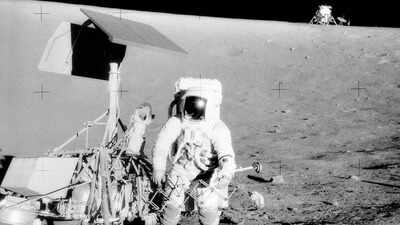
Apollo 12 splashed down safely on November 24, 1969, but four days earlier, part of the spacecraft never made it home. In an official report on the mission of Apollo 12 (December 1969) published by NASA, it is mentioned that following the reunion of the crew members Charles Conrad and Alan Bean with Richard Gordon in lunar orbit, the ascent stage of the lunar module Intrepid, after it was emptied, was deliberately crashed into the surface of the Moon. The maneuver was deliberate. It was a calibrated experiment, designed to give scientists a known, precisely timed seismic signal they could use to test an instrument the astronauts had just left behind on the surface.The ALSEP seismometer, three meters from the landing siteAs NASA’s Apollo 12 mission page explains, the mission included deploying the Apollo Lunar Surface Experiments Package (ALSEP), and Conrad and Bean deployed the Passive Seismic Experiment (PSE) that was part of it. The PSE was set up about three meters from the ALSEP central station and connected to it by a ribbon cable. The experiment was meant to record any kind of seismic activity on the Moon. The equipment was capable of amplifying slight vibrations in the ground by as much as ten million times. The Moon’s quiet, dry environment made it easier to detect seismic signals than it would be on Earth. After the astronauts returned safely to the orbiting spacecraft, mission controllers commanded a controlled burn of the ascent stage’s remaining propellant, which sent the stage out of orbit and down toward the surface, as NASA’s history of the mission describes. NASA’s National Space Science Data Center lists the impact of Intrepid’s ascent stage at 22:17 UTC on November 20, at a velocity of 1.68 kilometers per second, or roughly 6,050 kilometers per hour.Latham’s 1970 Science paper: a 55-minute signalWhat came back on the seismometer’s readout caught the science team off guard. In the paper Seismic Data from Man-Made Impacts on the Moon, published in Science in 1970, geophysicist Gary Latham and his colleagues reported unusually long reverberations from two lunar impacts, one of them Intrepid’s ascent stage, recorded by the seismic station the Apollo 12 astronauts had installed on the lunar surface. The signal built slowly to a peak and then decayed gradually. The abstract of the paper explains that dispersion and scattering of surface waves probably account for the reverberation, which points to heterogeneity in the outer mare on a scale of several hundred meters or less to several kilometers.Blanchette-Guertin’s 2012 study of the megaregolithIt took decades of additional analysis to work out more of the mechanism. Reexamining archived Apollo seismic recordings with modern computational methods, researchers Jean-Francois Blanchette-Guertin, Catherine Johnson, and Jesse Lawrence published Investigation of Scattering in Lunar Seismic Coda in the Journal of Geophysical Research: Planets in 2012. Parameters were estimated for the coda decay of 369 higher-quality lunar seismograms in 72 seismic events to determine how the parameters were affected by the kind of event, frequency range, and epicentral distance. It was found that scattering in a near-surface global layer was important for shallow events, particularly above 2 Hz.
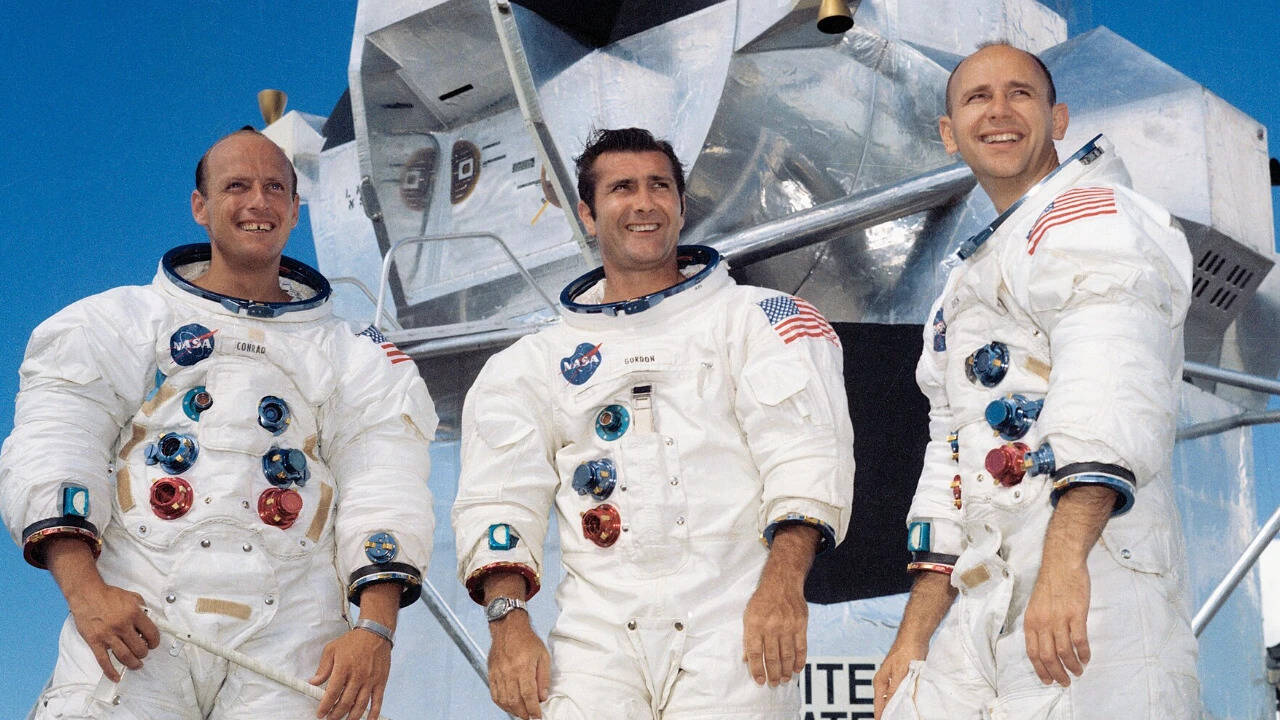
Portrait of the prime crew of the Apollo 12 lunar landing mission. Image credits: Wikipedia
Seismic waves may scatter through such layers multiple times, bouncing off tiny cracks and boulders before escaping the medium. They turn coherent seismic energy into diffuse energy with long-lasting echoes. Moreover, Latham and his colleagues found that absorption of seismic waves in the outer lunar crust is extremely low compared with typical continental crust on Earth, so more of the energy from a single impact is preserved. Thus, a single sharp blow will resonate in the medium for a much longer period than would be expected on Earth.The Apollo network’s later impacts, active until September 1977The reporting of the Apollo 12 impact popularized the phrase that the Moon “rang like a bell,” which later fed speculation that the Moon might be hollow. Later Apollo missions followed the same pattern, deliberately crashing more ascent stages and third stages from Saturn V rockets to add further calibrated seismic tests of the four-station Apollo network, which operated until its instruments were commanded into standby mode on September 30, 1977, as part of the shutdown of the surface stations, according to NASA’s National Space Science Data Center. This later data did not support the idea that the Moon was hollow. Rather, what the impacts all showed was that the Moon was an object whose outer crust was so fractured and whose inner parts absorbed so little seismic energy that even one minor impact could set off a series of echoes that lasted almost an hour.


