
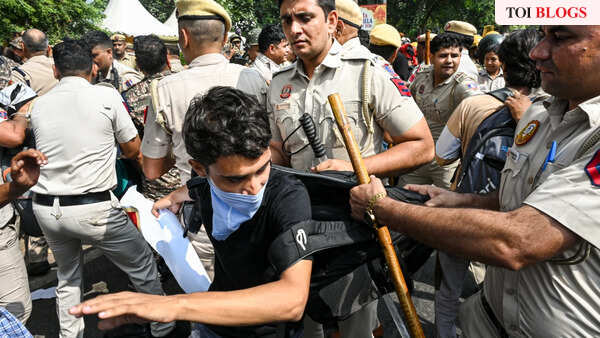
The CJP, the SIR, and the Anatomy of a Protest That Cannot EndThe Cockroach Janta Party is back in the heart of the capital. This time the target is not a minister, but the referee of Indian democracy itself. On October 10, the youth-led movement that forced Education Minister Dharmendra Pradhan’s resignation in July, attempted its “Jantar Mantar 2.0,” demanding the resignation of Chief Election Commissioner Gyanesh Kumar over the Special Intensive Revision (SIR) of electoral rolls.The immediate trigger is real and specific. A September 23 Indian Express investigation revealed that two Election Commissioners had formally objected at least 14 times over ten months to decisions taken by the poll panel under Gyanesh Kumar. Some of these decisions, the two commissioners said, were taken without their knowledge. Since the SIR began in Bihar in June 2025 and expanded nationwide, more than 130 million names have been removed from draft voter lists.The CJP’s demands have hardened accordingly: Kumar’s resignation and a criminal investigation, a halt to SIR exclusions, restoration of the January 2025 electoral rolls pending verification, transfer of the relevant records to the Supreme Court or an independent judicial inquiry, repeal of the 2023 law governing the appointment of election commissioners, and a boycott of elections altogether so long as Kumar remains in office. The Election Commission denies wrongdoing, insisting that operational queries raised during drafting are standard practice and that all SIR decisions were taken unanimously by the three-member body.The mobilisation has spread. A CJP rally at Mumbai’s Shivaji Park and protests at Jantar Mantar on October 2 (Gandhi Jayanti) were followed by an INDI Alliance march to the Election Commission on October 6, at which Rahul Gandhi, Priyanka Gandhi Vadra and other opposition MPs were detained. The CJP’s October 10 call drew student groups, civil-society organisations, farmer bodies and a coalition of opposition parties.Everything now unfolding in Delhi follows a pattern that has become unmistakable. It has repeated, almost to the letter.The goalposts keep changing. The CJP began with exam paper leaks and the demand for a minister’s scalp. It moved from “fix the exams” to “sack the minister” to “apologise to students” to “compensation for suicide families” to “withdraw all FIRs.” Pradhan resigned. Within 48 hours, the movement had found a new front. Now the grievance has migrated from the examination system to the electoral roll, from a minister to the Chief Election Commissioner. Each resolution opens a new front; each concession becomes the platform for the next demand. The issue changes; the structure does not.The movement has no ability to effect closure. It is leaderless, decentralised, horizontally organised. This is a strategic strength: with no head to strike, the state cannot decapitate it. But it is also a structural disability: with no leadership that can negotiate or sign, there is no mechanism to accept a settlement. Every demand met is reframed as insufficient; every victory is treated as a down-payment. The July experience proved this when a protest permitted for one day ran for a month.Political actors enter and make hay with the confusion. In Delhi and Mumbai, AAP leaders, the Left and its student wings (AISA and SFI), NSUI, Congress, RJD, Shiv Sena (UBT) and MNS leaders all attached themselves to a movement that was not theirs. Uddhav Thackeray and Raj Thackeray led the Mumbai march; Rahul Gandhi and Priyanka Gandhi Vadra were detained at the Election Commission march. They compete to own the agitation while it suits them, and they have every incentive not to let it close, because a simmering grievance is a permanent campaign platform.Also Read| The students deserved justice. India deserves reformIt is not in their interest to allow closure. A resolved grievance is a lost opportunity. A simmering one is an annuity.This is not uniquely Indian. In Kenya, the Finance Bill was withdrawn and the cabinet sacked, yet protests continued. In Bangladesh, the quota was cut, yet the movement escalated to regime change. In Nepal, Peru and Indonesia, the same dynamics played out. The grievance changes with the country; the anatomy is the same.The police are handed a task that has no clean answer. Having watched the last protest break its own undertakings when a one-day permission that ran for a month, more than 200 police personnel injured, thousands with criminal antecedents in the crowd, women constables molested, the security apparatus this time took no chances. It shut central Delhi down.The reasoning is not irrational. Jantar Mantar holds about a thousand people; the CJP claimed it would bring twenty thousand. Constitutional bodies such as the Election Commission and Parliament sit in New Delhi. The police argue they have a duty to residents, commuters and the economy of a capital that cannot be halted for every protest, and that permission is not anti-democratic but a mechanism to plan for safety, traffic and emergency access.But the crackdown carries its own cost. When a state shuts 45 metro stations, suspends mobile internet, cancels 200 trains and detains hundreds, it converts a protest about democratic legitimacy into a spectacle of democratic foreclosure. It creates exactly the grievance it claims to contain. The Supreme Court’s warning, do not use a hammer to kill a fly, captures the trap precisely.But one feels for the police. They are damned if they do and damned if they don’t. Allow the protest, and if a fraction of the crowd turns violent, the state is blamed for the disorder, while the movement gains its martyrs. Prevent it, and the state is blamed for authoritarianism and the movement gains its grievance. Either way, the movement grows. The police are being asked to solve, with barricades and batons, a problem that is not a law-and-order problem at all. It is a political one.How, then, can any of this be controlled?The answer rests on a single core insight: the cycle of simmering discontent survives because three things are true at once. The structural grievance is real, the movement has no mechanism to accept closure, and political actors benefit from keeping it alive. A counter-strategy must work on all three fronts simultaneously. No single move is sufficient.The first step must be to acknowledge the real grievance. The voter-roll question is not invented. Fourteen repeated internal objections, 130 million names removed, and a genuine loss of public trust in the Election Commission are real. The government’s first move should be to say so, in its own voice, rather than leading with conspiracy allegations. India’s Supreme Court itself advised during the NEET protests: “Listen to Gen Z, do not repress them… The most powerful resource is reasoning.” Acknowledgment denies the opposition the monopoly on speaking for the voter. But it must be followed immediately by substance. A purely rhetorical acknowledgment that fixes nothing is worse than silence, because it confirms that only pressure works.Then, don’t be reactive. Reactive government loses. Each time the movement raises a new demand, the state scrambles. The counter is to proactively announce a comprehensive package that addresses not just the current demand but the ones the movement will inevitably escalate to: an independent audit of the SIR, restoration timelines, judicial supervision of the roll revision, and the question of the appointment law. The UNDP’s protest-response framework calls this creating “institutional mechanisms to process demands”. Without them, mobilisations produce greater frustration and, potentially, violence. If you concede at peak momentum, you credit the protest; if you concede early and comprehensively, you credit governance. The same concession, timed differently, produces opposite political outcomes.Also, Fix the structure, not the symbol. A Chief Election Commissioner’s resignation without electoral-roll reform is a scalp that emboldens the next movement. Across the global wave, the recurring failure is symbolic concession with the structure left intact.Also Read| NEET protests: A double tragedy for students and a warning for the systemMake reform verifiable. Gen Z are digital natives who do not rely on mainstream media; their understanding is shaped by platforms, peer networks and first-hand experience. They are hard to gaslight and hard to satisfy with press releases. Proactive information sharing builds trust, while withholding creates suspicion. If the government is genuinely fixing the roll, transparency becomes its strongest defence, not press conferences, not IT-cell counter-narratives, but verifiable data.Do not feed the martyr machine. Every crackdown creates new grievances that become new demands.The UN Model Protocol is clear: states should foster a climate that respects and promotes the right to peaceful assembly.Build institutional channels so the street is not the only venue. If the only way to be heard is street protest, street protest recurs. In Thailand, the Gen Z movement converted its protest energy into a political party that won the most seats in 2023, and the street energy subsided because there was an institutional channel. In Bangladesh, where no such channel existed, the movement escalated until it toppled the government. Result? The youth found themselves iced out of the transition. Give them a seat at the table before they overturn the table.Expose political manipulation, but first, establish credibility. The instinct to lead with foreign-funding and conspiracy allegations before establishing credibility on the substance backfires. It looks like deflection, and the opposition dismisses it as a predictable template. If the funding is genuinely illicit, prove it through due process and prove it after fixing the real grievance, not before. The sequencing is critical: first acknowledge the genuine grievance, then announce structural reform, then, having established credibility, transparently investigate and expose manipulation through proper institutional channels. Accommodate first on the genuine grievance; confront the manipulation second, not the reverse.As said earlier, the cycle survives because three things are true at once: the structural grievance is real, the movement has no mechanism to accept closure, and political actors benefit from keeping it alive. You cannot address only one. If you fix the structure but do not build institutional channels, the next trigger produces the next eruption. If you build channels but do not fix the structure, the channels lose credibility. If you do both but do not expose the manipulation, the manipulators keep engineering new triggers. The counter-strategy has to work on all three fronts simultaneously: resolve the structural grievance visibly and verifiably, build institutional channels so protest is not the only path, and expose political manipulation through credible institutional processes after establishing your own credibility on the real issue. No single move is sufficient. The combination is what breaks the cycle.A republic that can only answer a protest with a lockdown, and a protest that can only answer a concession with a new demand, are trapped in the same loop. The way out is not more barricades or more hashtags. It is to make the grievance real, the reform visible, and the channel open.The movement must have somewhere to go other than the street, and the state must have something to offer other than force..
Disclaimer: Views expressed above are the author’s own.


