
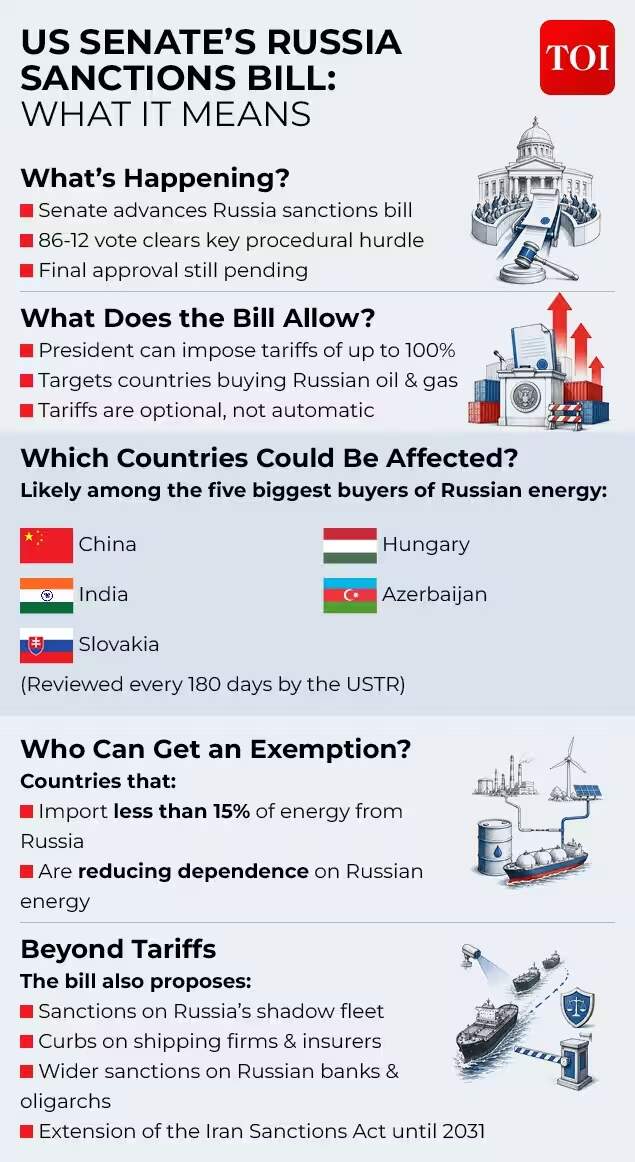
India faces the fresh prospect of being levied up to 100% tariffs if the Donald Trump administration is able to get a new Russian sanctions bill cleared and the US President exercises the power the bill would give to impose duties. An Indian government source told Reuters that while the sanctions bill on Russian oil purchase is a matter of concern, talks so far have been reassuring.The proposed Lindsey O. Graham Sanctioning Russia and Iran Act of 2026 would empower the US President to levy tariffs of up to 100% on countries that purchase large volumes of crude oil and natural gas from Russia. The final decision on whether to impose such tariffs would rest solely with the US President.Based on current import patterns, the five largest buyers of Russian energy are expected to include China, India, Slovakia, Hungary and Azerbaijan.Also Read | 100% tariffs: Why India may ignore Trump threat and continue buying Russian crude oil
‘Trump, PM Modi good friends’
Meanwhile, White House Trade Adviser Peter Navarro said on Tuesday that US President Donald Trump and Prime Minister Narendra Modi share a “very good working relationship” and are expected to address differences over Washington’s proposed tariffs on countries purchasing Russian oil through direct engagement.His remarks came just days after the US Senate approved the bipartisan Bill. The proposed legislation is aimed at increasing economic pressure on Moscow by targeting countries whose purchases of Russian energy are viewed as helping finance its war in Ukraine.
What US sanctions bill for Russia means
Replying to a question from ANI, Navarro said the matter would be resolved by the two leaders themselves rather than by other officials. “The president and your prime minister have a very good working relationship. They are going to work that out amongst themselves, and it’s not for me or any gaggle to get between that,” he said.Navarro also reiterated his criticism of India’s imports of Russian crude, contending that New Delhi’s involvement in the trade expanded significantly only after Russia launched its invasion of Ukraine in 2022.India continues to be one of the biggest importers of Russian crude, with purchases rising sharply after the Russia-Ukraine conflict began in 2022. Access to discounted Russian oil has enabled Indian refiners to lower input costs while ensuring uninterrupted supplies during a period of volatility in global energy markets.Navarro’s latest remarks represent a noticeably more conciliatory stance on India-US ties after months of sharp criticism. Earlier in 2026, he had repeatedly targeted India over its Russian oil imports and had referred to the country as the “Maharaja of tariffs”.Also Read | Beijing’s billion-barrel weapon: Why India must prepare for China-driven oil prices


