
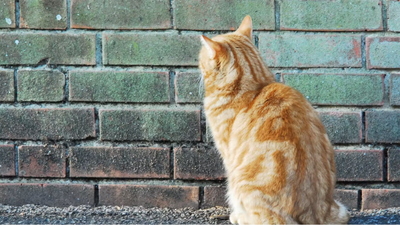
A cat suddenly stops, sits still and stares at one spot on a wall. There is nothing obvious there. No insect, no movement and no sound that you can detect. Yet the cat remains focused on the same patch for several seconds, sometimes much longer. It can look mysterious, but there are several ordinary explanations for this behaviour. Cats experience their surroundings through senses that are different from ours, and something that appears to be an empty wall may not be empty to them.
Your cat may be hearing something you cannot
One of the simplest explanations is sound. Cats have a much wider hearing range than humans. A 1985 studypublished in Hearing Research measured the hearing range of domestic cats and found that, under the conditions tested, they could hear frequencies from 48 Hz to 85 kHz. The researchers described this as one of the broadest hearing ranges among mammals. This means a cat sitting in front of a wall may actually be listening rather than staring. A faint sound from inside a wall, a nearby room or outside the house may catch its attention even when the same sound is below our hearing threshold. Cats can also locate sounds with considerable accuracy. A separate study of domestic cats examined their ability to locate sounds coming from different directions and found that they could use differences in sound reaching their two ears to determine where a sound was coming from.So if a cat repeatedly looks toward one section of a wall, it may have detected a sound coming from that direction.
Sometimes the wall is not actually empty
Cats can also notice small movements that humans overlook. Their eyes are adapted for hunting in relatively low light. Cats have a reflective layer in the eye called the ‘tapetum lucidum.’ Research on the structure of the cat’s tapetum has shown that it reflects light back through the retina, giving light-sensitive cells another opportunity to detect it and improving visual sensitivity in low-light conditions. That does not mean cats can see in complete darkness. They still need some light. But in dim conditions, a tiny insect, moving shadow or small change in the environment may be easier for a cat to notice. A cat may therefore be watching something as simple as a small insect on the wall, a moving speck of dust or a faint shadow that a person has not noticed.
They may also be following a familiar spot
Cats do not necessarily need a visible object to keep returning to the same place. If a particular section of a wall has previously been associated with a sound or movement, the cat may pay attention to it again. For example, a sound inside a wall may occur at roughly the same time each day, or an insect may repeatedly appear around the same area.Veterinary experts also point out that cats can spend considerable time focusing on a location when they believe prey may be present. This is particularly relevant because cats are predators and are naturally sensitive to small movements and high-frequency sounds.
Sometimes they may simply be watching
Not every episode of wall-staring has to mean that the cat has detected something unusual. Cats spend a large part of their day observing their surroundings. A cat may sit quietly and focus on an area without immediately moving toward it. In such cases, the behaviour may simply be part of normal attention and exploration. The important clue is what happens around the staring. If the cat’s ears move toward a sound, its eyes track something, or it suddenly becomes alert, there is a good chance that it is responding to a sensory stimulus.
When staring at a wall can be a health concern
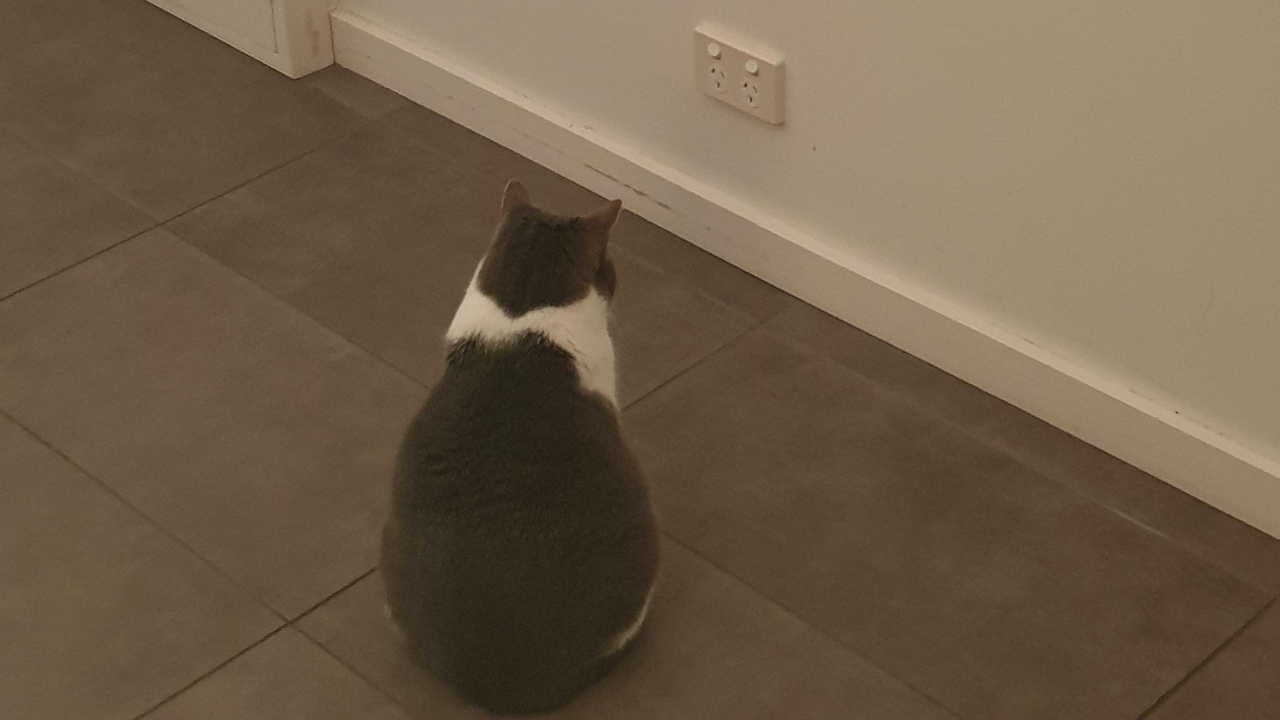
There is another side to this behaviour, particularly in older cats. Long periods of staring at walls or into empty space can occur as one of the behavioural changes associated with feline cognitive dysfunction. Cornell University’s College of Veterinary Medicine lists blank staring at walls or into space among the signs that can occur in older cats with cognitive dysfunction. Other changes can include disorientation, altered sleep patterns, wandering, changes in interaction and unusual vocalisation. Research on feline cognitive dysfunction has also documented changes such as disorientation, altered activity, changes in sleep-wake cycles and learning or memory problems.Staring alone does not mean that a cat has cognitive dysfunction. It becomes more important when it appears alongside other changes in an older animal.
What if the cat seems completely unresponsive?
A cat that occasionally looks at a wall and then goes back to normal is usually very different from a cat that has repeated episodes of staring, appears unaware of its surroundings or develops other unusual movements. According to some veterinary references, focal seizures can sometimes involve staring and altered awareness. This is one reason sudden or persistent changes in behaviour should not simply be dismissed as a quirky cat habit. If staring episodes are frequent, prolonged or accompanied by disorientation, unusual vocalisation, twitching, loss of balance or other changes, a veterinary examination can help determine the cause.
So, what is your cat actually staring at?
In many cases, probably something that is real but too subtle for you to notice. A cat may hear a sound behind the wall, detect a tiny movement, notice an insect or simply focus on a familiar location. Its wide hearing range and eyes adapted for low-light conditions give it access to parts of the environment that humans experience differently. And sometimes, there may be no obvious stimulus at all.The important point is that a cat staring at an “empty” wall does not automatically mean it is seeing something mysterious. More often, it is responding to its environment in a way that humans cannot easily detect. When the behaviour is new, persistent or accompanied by other changes, however, it is worth treating it as a possible health clue rather than just another strange cat habit.


