

NEW DELHI: India’s cheapest smartphones are disappearing fast. Rising component costs have made sub-$100 (around Rs 9,000) devices increasingly unviable for manufacturers, while giving older 4G technology an unexpected lifeline as brands look for ways to keep phones affordable for budget buyers.Shipments of smartphones priced below $100 plunged 74.3% year-on-year during the April-June quarter, according to IDC. The segment’s share of India’s smartphone market shrank to just 4.5% from 15.6% a year earlier, marking a sharp erosion of the traditional entry-level market.
The downturn has also hit Chinese smartphone brands particularly hard
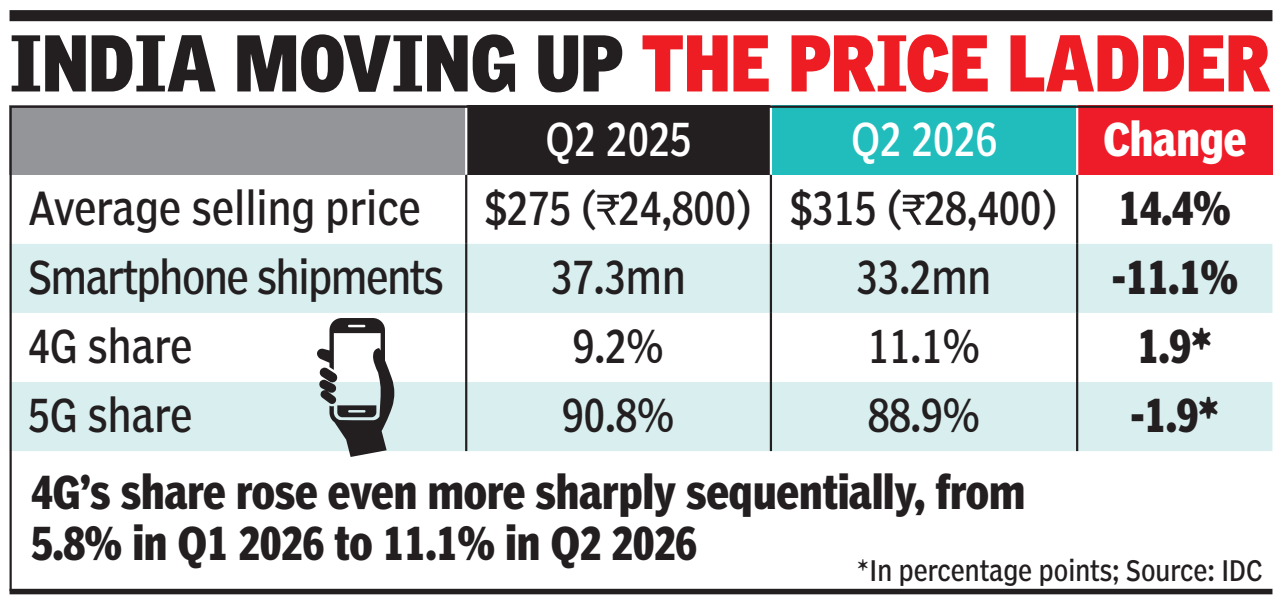
Overall smartphone shipments declined 11.1% to 33.2 million units. However, average selling prices (ASP) climbed 14.4% to a record $315 (around Rs 28,400), as higher memory and component costs filtered through product line-ups. Vendors also reduced discounts to protect margins, while the sharp contraction of entry-level shipments and growing sales of premium devices pushed the market’s overall price mix upwards.The affordability squeeze is pushing buyers further up the price ladder. While the sub-$100 segment collapsed, the $100-200 (around Rs 9,000-18,000) category accounted for 46.8% of shipments and remained broadly flat. The $400-600 (around Rs 36,000-54,000) segment grew 60.3% year-on-year, with its share nearly doubling to 8.6% from 4.8%.“Q2 2026 saw average selling prices climb 14.4% year over year to a record $315, with memory driven cost pressure showing up across the product lineup,” said Aditya Rampal, senior research analyst, devices research, IDC Asia Pacific.The same cost pressure is also changing the 4G-5G mix. As entry-level 5G smartphones became more expensive, several brands reintroduced or extended 4G models to retain buyers at the lower end. This lifted 4G’s share of smartphone shipments to 11.1% during the quarter.IDC, however, sees this as a supply-led stopgap rather than a reversal of India’s migration towards 5G. Once existing 4G inventory runs out, consumers at the bottom end could have little choice but to move to more expensive 5G devices.The downturn has also hit Chinese smartphone brands particularly hard. Market leader Vivo’s shipments fell 13.9%, while Xiaomi declined 10%, Oppo 8.5% and Realme 14.2%. Poco fell 12.3%, while iQoo shipments plunged 61%.The pressure could intensify in the second half as brands exhaust lower-cost component inventory and head into the festive season with less room for discounts.“Demand hasn’t gone away, people are simply waiting longer to buy and those planning an upgrade may want to move sooner rather than later, before prices go up further,” said Upasana Joshi, senior research manager, devices research, IDC Asia/Pacific.IDC expects smartphone shipments to decline more than 15% in the second half of 2026, taking full-year volumes to roughly 128-130 million units.


