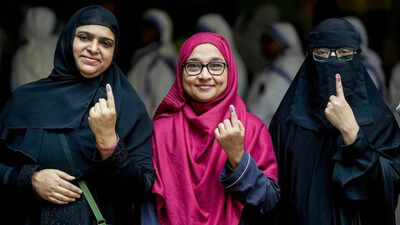
NEW DELHI: Often a decisive factor, Muslim voting patterns took sharply different turns across states this election, fragmenting in West Bengal, consolidating behind the Congress-led front in Kerala, and shifting decisively towards Congress in Assam, reshaping outcomes in constituencies where the community holds disproportionate influence.
West Bengal: Fragmented minority vote dents Trinamool, aids BJP surge
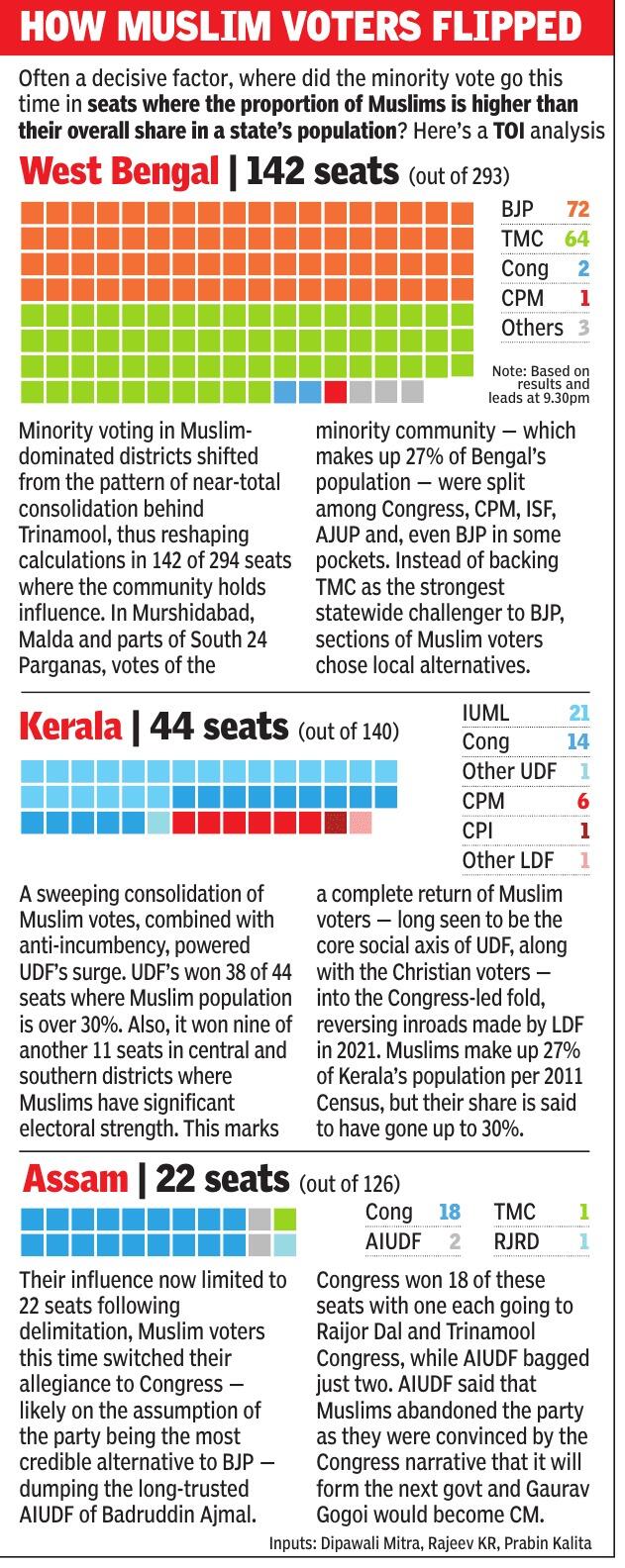
In West Bengal, the most striking shift was the breakdown of near-total minority consolidation behind Trinamool Congress, long seen as the party’s biggest electoral cushion.Across 142 minority-influence seats, the outcome tilted sharply: BJP won 72, Trinamool Congress 64, Congress 2, CPM 1, and others 3.In districts such as Murshidabad, Malda, North Dinajpur and parts of South 24 Parganas, Muslim voters dispersed across Congress, Left parties, ISF, smaller outfits like AJUP, and even, in pockets, the BJP.“This is the first time in Bengal’s history after Independence that the minority community did not vote collectively,” said political analyst Udayan Banerjee.
The fragmentation came at a time when BJP successfully consolidated Hindu votes, creating a dual shift that worked against Trinamool. Political scientist Zaad Mahmood noted, “We saw a crucial shift where the Muslim vote split, while a large portion of the majority Hindu vote consolidated in favour of the BJP.”The shift was visible even in industrial belts like Howrah and Barrackpore, where economic distress and factory closures drove disillusionment.The fragmentation unfolded against deep anti-incumbency, anger over corruption, and governance failures — from recruitment scams to protests after the RG Kar hospital incident. Economic distress added another layer. In industrial belts like Howrah and Barrackpore, job losses, migration and factory closures weakened traditional loyalties, with sections of Muslim worker communities drifting away from Trinamool.
Kerala: Minority consolidation powers UDF landslide
In contrast, Kerala witnessed a near-complete consolidation of Muslim votes behind the Congress-led United Democratic Front (UDF), which became a decisive factor in the alliance’s sweeping victory.Across 44 Muslim-influence seats, the distribution stood as follows: IUML won 21 seats, Congress 14, other UDF partners 1, CPM 6, CPI 1, and other LDF constituents 1.The UDF dominated constituencies with significant Muslim populations, winning 38 of these 44 seats, with the trend extending beyond Malabar into central and southern Kerala.This marks a full return of Muslim voters to the UDF fold, reversing the gains made by the Left Democratic Front (LDF) in 2021. The consolidation, combined with anti-incumbency, reshaped the electoral landscape.The reasons were layered. A perception that CPM had recalibrated its politics towards majority appeasement, controversies during the campaign, and unease over leadership signals contributed to a growing trust deficit. Attempts by the LDF to counter this — including tactical outreach and counter-polarisation — largely failed, and in some cases backfired.With Muslims accounting for roughly 27% of Kerala’s population, the consolidation once again reaffirmed their role as a core pillar of UDF’s electoral coalition, alongside Christian voters.
Assam: Tactical shift to Congress within shrinking space
In Assam, Muslim voters largely consolidated behind Congress, but within a much narrower electoral space shaped by delimitation and political messaging.Across 22 Muslim-majority seats, Congress won 18, AIUDF secured 2, while Trinamool Congress and Raijor Dal got 1 seat each.The shift reflected a strategic choice by voters to back what they saw as the most viable challenger to the BJP, leading to a sharp decline in AIUDF’s influence.However, this consolidation also underlined Congress’s shrinking reach beyond minority-dominated pockets. Following delimitation in 2023, Muslim-majority seats dropped from 35 to 22, tightening the party’s electoral base.Chief minister Himanta Biswa Sarma’s sustained campaign portraying Congress as a party of “Miya” Muslims appeared to have further limited its broader appeal.


