
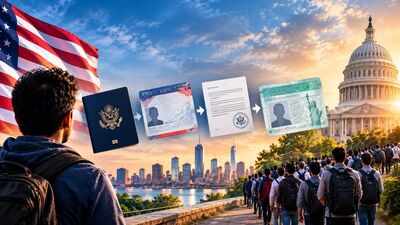
For years, the H-1B visa was the front door, and the green card was the destination. Indian technology professionals accepted the lottery odds, years in limbo and uncertainty because the pathway, however slow, was open. Now, both ends of that pathway are under pressure.With nearly 10 lakh Indians already in the US employment-based green-card backlog, the journey from temporary worker to permanent resident is becoming a two-sided squeeze: getting in is harder, while getting out of the visa queue can take decades.On September 8, US Department of Labor Inspector General Anthony D’Esposito announced that Cognizant’s new PERM filings had been suspended amid an investigation into alleged fraud and misuse of employment-based visa programmes.Days later, he said the same had happened to Cloudera. The department has not publicly disclosed the number of employees affected, the duration of the suspensions or detailed allegations against either company.Rajiv Dabhadkar, founder of the National Organisation for Software and Technology Professionals (NOSTOPS), told TOI,
“Cognizant’s PERM suspension sends a broader signal to employers and employees: immigration policy and sponsorship practices are no longer just HR considerations; they are becoming central to long-term workforce planning.”
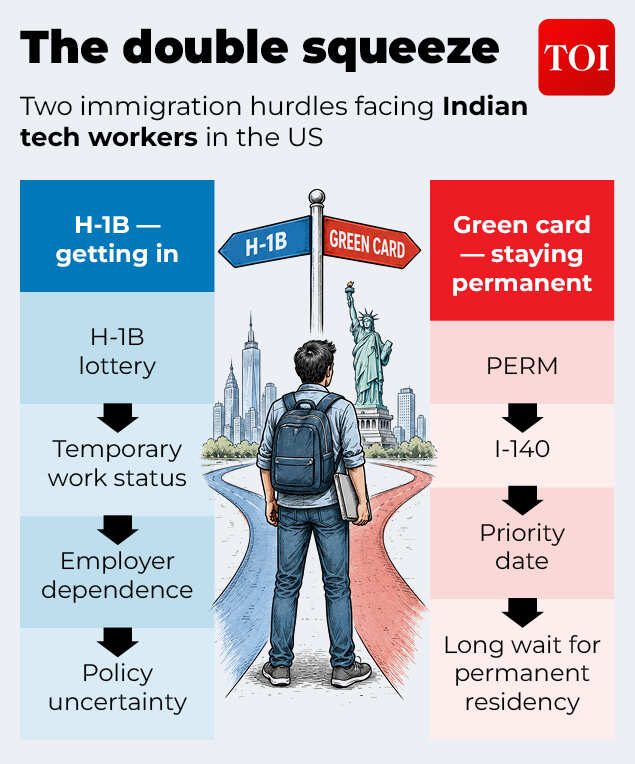
But the bigger story goes beyond one company. Indian professionals are caught between tighter scrutiny of temporary work visas and a permanent residency system where the wait for a green card is already extraordinarily long.Put together, these two trends describe something more specific than “tighter immigration policy”: they describe a double squeeze, a narrowing gate to enter the system and a barely moving line to exit it.What a PERM suspension actually changes, and what it doesn’tPERM, or Program Electronic Review Management, is generally the labour-certification stage in which a US employer seeks Department of Labor approval to sponsor a foreign worker for permanent residence.It is not the green card itself.Typical employer-sponsored green-card route
- H-1B visa → Work in the US
- PERM → Employer starts the labour-certification process
- I-140 → Employer files the immigrant petition
- Priority date → Worker waits for the date to become current
- I-485 / Consular processing → Apply for permanent residence
- Green card → Permanent residency is granted
That means a suspension of new PERM filings can prevent an employer from moving new workers into the permanent-residency process. It does not automatically mean that every existing H-1B worker’s visa or previously approved immigration case has been cancelled.That distinction matters because Cognizant’s development has created anxiety among Indian workers who may already be planning their careers around employer-sponsored permanent residence.But Cognizant’s PERM suspension does not by itself explain why Indian workers face such a difficult green-card journey. That problem existed long before the latest investigation.Dabhadkar said, “For Indian tech professionals, the emerging lesson is that a US job may be a career opportunity, but a US green card is a separate and increasingly uncertain proposition.”
The first squeeze: staying on H-1B
For many Indian technology workers, the H-1B is the entry point into a longer US career.The visa allows US employers to employ foreign workers in specialised occupations, including many technology roles. The system has an annual cap of 85,000 new H-1B visas: 65,000 under the regular quota and another 20,000 for foreign graduates with advanced degrees from US universities.Demand has long exceeded supply, making the selection process highly competitive.But the bigger issue for workers already in the US is that H-1B status is tied to employment. If an employee loses the job, immigration status can quickly become a problem.That risk could become even greater if a new proposal from the Department of Homeland Security is finalised.DHS has proposed removing the current discretionary 60-day grace period that allows certain H-1B and other employment-visa holders to remain in the US after their jobs end while looking for another employer or immigration option. The proposal is still subject to the rule-making process and is not current law.For an Indian worker who has spent years building a career in the US, that could turn a routine job change into an immigration emergency.
The second squeeze is much bigger: the green-card queue
This is where India’s immigration problem becomes very different from that of many other nationalities.The US limits employment-based immigrant visas and also applies a statutory per-country limit. India has far more applicants in employment-based categories than the available annual numbers can accommodate.The result is a massive backlog.A recent National Foundation for American Policy analysis estimated that nearly 1 million Indians are stuck in the US employment-based green-card backlog, accounting for nearly 79 per cent of the estimated 1.26 million people waiting in the first three employment-based categories.For some applicants, the projected wait is extraordinarily long. NFAP has estimated that an Indian professional entering the queue in 2026 could face a potential wait of 179 years in EB-2 and 38 years in EB-3, under its modelling assumptions.These are NFAP projections, not official government wait times, and actual waits can change with demand, visa availability and changes to US law.But what does a 179-year wait mean for a 22-year-old’s idea of the future? Dabhadkar said, “The precise number is almost beside the point. What matters is the mismatch between the time horizon of immigration and the time horizon of a human life.”
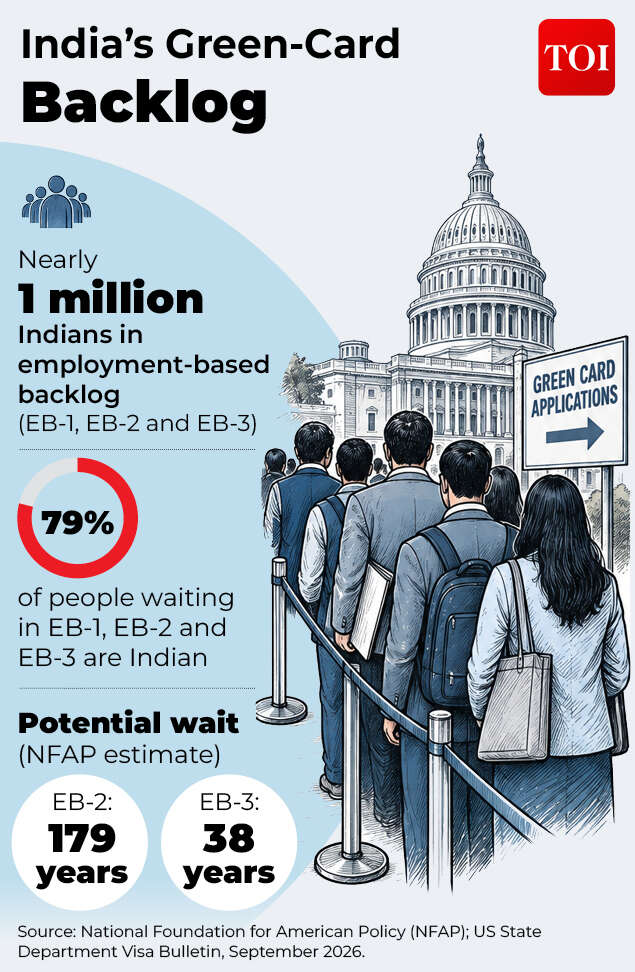
And that raises a question far larger than immigration: What happens to the American Dream after the American degree?For September 2026, the State Department lists India’s EB-2 category as unavailable for final action, while the EB-3 final action date is January 1, 2014 and EB-1 is October 15, 2022.These dates determine whether a worker who has completed years of employment and employer sponsorship can actually receive permanent residence.The State Department has also said all available FY2026 EB-2 immigrant visas for India had been used.
Why does India have such a huge queue?
The basic problem is a mismatch between how many Indians seek employment-based permanent residence and how many visas are available under US law.India produces a large pool of engineers, software professionals and other highly skilled workers who seek jobs in the US. Many enter through the H-1B system and later seek employment-based green cards.But employment-based immigration numbers are limited.The State Department says the worldwide employment-based preference limit for FY2026 is 186,317, while the per-country limit is set at 7 per cent of the combined family-sponsored and employment-based preference limits, subject to statutory rules and exceptions.
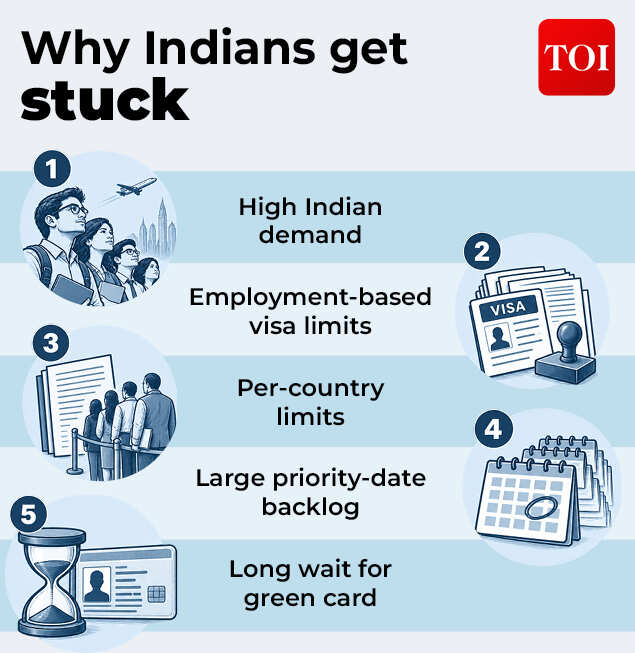
India is one of the countries whose applicants are oversubscribed. That creates a peculiar situation.An Indian engineer can have a highly paid job, an advanced degree, a US employer willing to sponsor a green card and years of tax and employment history in America, yet still have to wait for a visa number to become available.
What happens to a worker caught in the middle?
For an Indian technology professional, getting an H-1B is just the beginning. The worker may spend years changing employers, extending H-1B status and waiting for an employer to start and progress a green-card application.That dependence can create another layer of uncertainty. A delay in PERM can push back the green-card process, while an employer ending sponsorship can force the worker to explore another immigration route. Even after reaching later stages, the Indian priority-date backlog can keep permanent residence out of reach.The result is two timelines moving at different speeds: temporary status depends on continued employment, while permanent residence can remain years away.
The pressure is spreading beyond green cards
The green-card queue is only one part of the squeeze. The H-1B system itself is facing a more restrictive environment.The administration has pursued higher costs, greater scrutiny and changes to employment-visa rules.At the same time, Indian IT companies have already been reducing their dependence on new H-1B workers.An NFAP analysis of USCIS data found that seven major Indian-based IT companies received 4,573 approvals for H-1B petitions for initial employment in FY2025, down 37 per cent from FY2024 and 70 per cent from 2015.Cognizant’s own figure in that analysis fell sharply, from 2,873 approvals for initial employment in FY2024 to 743 in FY2025.
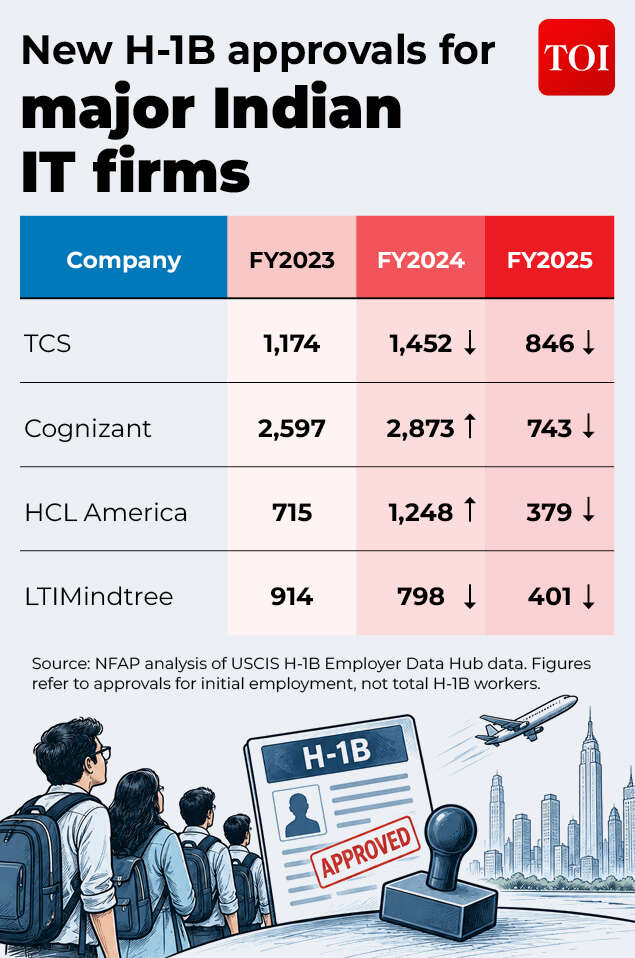
The decline does not mean Indian IT companies no longer need H-1B workers. Rather, companies have increasingly relied on local US hiring, offshore delivery and other locations to reduce dependence on moving workers through the H-1B system.For individual Indian professionals, however, that shift offers little comfort if they are already in the US and waiting for permanent residence.
From temporary worker to permanent resident: where is the exit?
That is the central question facing many Indian technology workers.The US remains one of the world’s biggest technology markets, and companies continue to need skilled professionals. But for an Indian worker, getting into the US labour market and securing permanent residency are increasingly separate challenges.H-1B can get the worker into the US. It does not guarantee a green card.PERM can start the employer-sponsored permanent-residency process. It does not guarantee a green card.And even an approved immigrant petition does not necessarily mean an Indian applicant can immediately become a permanent resident, because the priority-date backlog can remain.It shows how a worker’s path to permanent residence can be affected by employer-level immigration scrutiny even before the worker reaches the already crowded green-card queue.For Indian tech workers, that is the real double squeeze: the rules governing the temporary route are becoming more uncertain at the same time that the permanent route remains heavily backlogged.The result is a rising group of highly skilled professionals who may have lived, worked and built careers in America for years, yet still cannot say when the temporary chapter of their immigration journey will finally end.


