
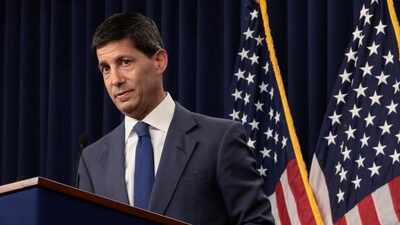
US Federal Reserve Chair Kevin Warsh-led Federal Open Market Committee (FOMC) on Wednesday hiked the key interest rate to 3.75%-4% target range. This is the first interest rate hike since 2023.“The Committee decided to raise the target range for the federal funds rate by 1/4 percentage point to 3-3/4 to 4 percent, in support of the Federal Reserve’s dual mandate. The Committee is continuing its policy of maintaining ample reserves in the banking system,” the FOMC statement said.“Economic activity is expanding at a solid pace. While uncertainty remains elevated owing, in part, to geopolitical developments, domestic spending has been resilient. Productivity growth is strong, and capital investment is robust. Job gains have kept pace with the workforce, and the unemployment rate has changed little. Inflation remains elevated. Today’s policy action will support a timelier return to the Committee’s 2 percent goal. The Committee will deliver price stability,” it added.
US Federal Reserve Projections & Outlook
Federal Reserve officials now expect to raise interest rates once more this year, following Wednesday’s quarter-point increase, while their latest quarterly projections indicate that rates are likely to remain unchanged in 2027.The projections, released after the Fed’s latest policy meeting, also showed that policymakers have raised their expectations for inflation in the near term.The new projections indicate that rates could begin moving lower again in 2028, with the federal funds rate expected to be in the 3.5%-3.75% range in 2029.The outlook has changed from the Fed’s June projections. At that time, officials had also anticipated one quarter-point increase during 2026, but they expected rates to decline by the same amount in 2027.Policymakers are now forecasting higher inflation for 2026 and, to a lesser extent, the years that follow.The median projection for inflation, measured by the personal consumption expenditures (PCE) price index, is now 3.7% for 2026, compared with the 3.6% forecast issued in June. Officials continue to expect PCE inflation to ease to 2.3% next year, while the projection for 2028 has risen to 2.1% from the earlier 2% estimate.The projections indicate that the Fed does not expect inflation to return to its 2% target until 2029.The outlook for economic growth and employment, meanwhile, has remained largely steady. Fed officials now expect GDP to expand 2.3% in 2026, slightly higher than the 2.2% forecast in June. Growth is projected at 2.4% in 2027.The unemployment rate is currently 4.1% as of August, and policymakers expect it to remain at that level through the end of 2026 and stay there through 2029.The hike comes on the back of persistent inflation and a broader increase in global borrowing costs. Inflation has remained stubbornly elevated, while borrowing costs around the world have moved higher.The move runs counter to President Donald Trump’s expectations when he appointed Warsh to head the Federal Reserve earlier this year. Trump had said he expected his choice to cut interest rates. More recently, the president threatened to impose additional import tariffs if the Fed failed to lower borrowing costs.Financial markets had placed strong bets on a 25-basis-point increase in the Fed’s benchmark rate. A quarter-point increase had increasingly come to be viewed as almost unavoidable, with inflation remaining above the Fed’s 2% target, longer-term borrowing costs globally moving higher and questions surrounding how far Warsh is prepared to resist Trump’s calls for lower rates.The projections released in June showed a near-even split among policymakers. Nine of the 19 officials expected rates to rise by at least a quarter of a percentage point by the end of 2026, while another nine saw rates either staying at their existing level or falling by a quarter of a percentage point.The balance has shifted toward a rate increase since then. Three policymakers dissented at the July 28-29 meeting in favour of raising rates, while several others have subsequently indicated they were prepared to support an increase unless inflation began to ease soon.That improvement in inflation has not materialised.The Personal Consumption Expenditures Price Index, which the Fed uses to measure progress toward its 2% inflation target, rose at an annual rate of 3.7% in both June and July following a sustained increase through much of last year. The next reading, due on September 30, is expected to show little change, if any.Many economists continue to expect inflation pressures to moderate eventually. But a renewed increase in oil prices above $100 a barrel, Trump’s announcement of new tariffs on Canada, his warnings that additional import duties could follow, and continued economic growth driven by heavy AI spending have created enough inflation risk for Fed officials to consider tightening policy.Warsh pointed to those concerns in his recent Jackson Hole speech. He said policymakers needed to be confident “that underlying inflation is moving to our objective, clearly and at sufficient speed,” while adding that recent data “do not tell me that underlying trends have meaningfully improved.”


