
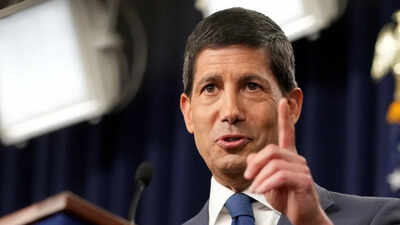
Federal Reserve Chair Kevin Warsh has indicated that the US central bank may need to raise interest rates in the coming months if inflation does not make enough progress towards its 2% target.Speaking at the Fed’s annual conference in Jackson Hole, Wyoming, on Friday, Warsh acknowledged that recent US data showed inflation had cooled somewhat. However, he said the figures did not indicate a meaningful improvement in underlying price pressures.“They do not tell me that underlying trends have meaningfully improved. We must be confident that underlying inflation is moving to our objective, clearly and at sufficient speed,” Warsh said, adding, “Otherwise, we have work to do.”The Fed chief did not suggest a rate hike was imminent, but his comments offered a clearer indication of his concerns about inflation. They also appeared to reassure Wall Street that controlling price pressures remains a priority for the central bank.
Inflation remains well above Fed’s target
Inflation stood at 3.7% in July according to the Fed’s preferred measure, well above its 2% target. Price pressures had cooled in June and July after rising sharply in May as gas prices surged.Warsh said inflation data “are more concerning” than trends in the labour market, where unemployment remains low. He also said inflation was unlikely to return to the Fed’s target on its own.More than half of the goods and services tracked by the government recorded price increases of 3% or more over the past year. While that was down from the pandemic peak, it remained “well above” the roughly one-third that recorded such increases in the two decades before the pandemic.
Markets raise rate-hike expectations
The speech pushed expectations for higher short-term interest rates higher in the bond market, although US stocks remained steady.The two-year Treasury yield, which closely tracks expectations for the Fed’s federal funds rate, rose from 4.22% to 4.30%.Investors now see the chances of a rate hike at the Fed’s September 15-16 meeting as roughly even, according to futures pricing tracked by CME FedWatch. Before Warsh spoke, the probability was about one-third.Longer-term Treasury yields were mostly unchanged. The 10-year and 30-year yields showed little movement, suggesting investors did not expect higher rates to remain necessary for a prolonged period to tackle inflation.Jon Faust, an economist at Johns Hopkins and former adviser to Jerome Powell, said Warsh had conveyed a tougher approach to inflation without giving the detailed policy guidance he has criticised.“He found a way to convey that if necessary he would support raising rates, which is one thing people were concerned about,” Faust said.Michael Strain, director of economic policy studies at the American Enterprise Institute, said Warsh had previously spoken toughly about inflation without raising the Fed’s key rate. He said Friday’s comments did not provide clearer guidance on the timing of a possible move.
Warsh avoids ‘forward guidance’
Warsh’s speech came after his July 29 press conference created uncertainty over whether his tough comments on inflation would be followed by action.The Fed’s short-term interest rate is currently about 3.6%. Warsh has said he does not want to provide “forward guidance” on whether the central bank will raise, cut or hold rates at upcoming meetings.He argues that committing to a particular policy path would limit the Fed’s flexibility. Some economists have said he could offer more insight into his views without signalling a specific future action.Warsh reiterated his scepticism towards such guidance on Friday.He also suggested that current interest rates were not restricting economic activity, pointing to strong consumer spending and robust business investment in AI equipment and infrastructure.Fed chair clarifies policy approachWarsh also sought to clear up confusion from his July 29 news conference over the inflation measure used by the Fed and its main tool for fighting price pressures.On Friday, he specified that short-term interest rates are the Fed’s “predominant tool” and said the central bank is using the same gauge it has long followed to measure inflation.Fed chairs have often used Jackson Hole speeches to discuss broad economic and monetary policy questions or signal changes in their approach. In 2022, Powell used the event to signal that the Fed would continue sharply raising rates after pandemic-era inflation reached 9.1%, warning that the measures would bring “pain” to consumers and businesses.
Trump keeps pressure on Fed
Warsh’s approach is being closely observed as US President Donald Trump continues to call for lower interest rates. Trump has defended Warsh, whom he appointed, while criticising other Fed officials who support higher rates.Trump has also renewed efforts to remove Fed governor Lisa Cook, appointed by former President Joe Biden. Replacing Cook would allow Trump to appoint a majority of the seven-member board. The US President tried to fire her last year but was temporarily blocked by the Supreme Court.Longer-term rates have risen in recent weeks amid factors including growing US government deficits and heavy borrowing by technology firms building AI infrastructure.The 30-year Treasury yield reached a 19-year high last week, prompting US treasury secretary Scott Bessent to make an unusual effort to buy back bonds and push yields lower.Warsh replaced Powell as Fed chair in late May after his predecessor’s term ended.


