
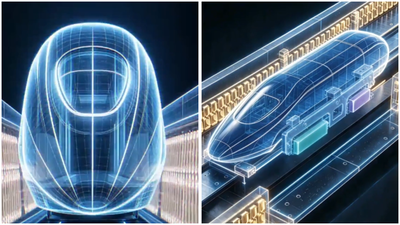
China has pushed maglev technology into a speed range far beyond conventional high-speed rail, with an experimental train car reaching 800 kmph in only 5.3 seconds on a 1-km test track in Hubei.The 1,110-kg test vehicle, developed at Donghu Laboratory, achieved the milestone in its latest trial, marking its third world record in six months.The experiment, however, is not aimed at putting passengers on trains travelling at 800 kmph.Instead, the technology could eventually have applications in rocketry, military aircraft, drones and industrial transport, where extremely rapid acceleration could be more useful.
How China’s experimental maglev works
Unlike conventional trains, maglev vehicles use magnetic forces to reduce or eliminate physical contact between the train and the track. Electromagnetic systems can both levitate the vehicle and propel it forward.China’s fastest commercial maglev service, the Fuxing system, has a top speed of about 217 mph (349 kmph. The experimental Donghu Laboratory vehicle is therefore operating at more than twice that speed.The latest test was carried out on a 1-km-long track in Hubei. According to CGTN, the system worked like a giant slingshot: magnetic forces propel the vehicle forward while eliminating the friction associated with conventional rail travel.The test vehicle has already broken its own short-distance acceleration record multiple times. Its first public run in June 2025 reached about 404 mph (650 kmph) in 7.1 seconds.Engineers subsequently raised the speed to about 433 mph (697 kmph) before reaching nearly 496 mph (798 kmph) in November.
Why reaching 800 kmph is so difficult
At such speeds, even tiny deviations in the track can become a major engineering challenge.The experimental system reportedly requires track alignment to remain within 0.5 millimetres.Control systems must simultaneously manage the vehicle’s position, levitation and electromagnetic propulsion while maintaining stability during rapid acceleration.The vehicle weighs around 1,110 kg, meaning enormous amounts of energy and force are required to accelerate it to such speeds within seconds.The trials have also helped researchers test technologies involving high-power energy delivery, levitation control, positioning, electromagnetic propulsion and emergency braking.
Could maglev technology launch rockets?
The biggest significance of the experiment may lie beyond railways.Passenger trains travelling at such speeds would require expensive infrastructure and enormous energy inputs, while acceleration levels involved in the tests would not be suitable for conventional commuter travel.Researchers are therefore exploring whether similar electromagnetic acceleration technology could eventually be adapted for rockets, drones and military aircraft.A ground-based launch system capable of giving a rocket or aircraft a substantial initial boost could potentially reduce the amount of fuel it needs to carry for take-off. Similar technology could also find applications in industrial transport and specialised elevators.For now, the technology remains experimental. China’s commercial maglev systems already demonstrate that magnetic levitation can deliver very high-speed passenger transport, but the leap from those systems to an 800-kmph experimental vehicle represents a very different engineering challenge.


