
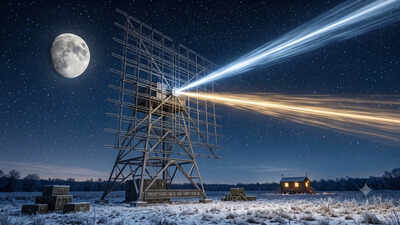
On January 10, 1946, a team of military and civilian personnel at Camp Evans, Fort Monmouth, New Jersey, aimed a modified radar system at the rising Moon and transmitted high-powered radio pulses toward its surface. About 2.5 seconds later, the oscilloscope registered a faint radio echo that had travelled to the Moon and back to Earth.According to historical records from the InfoAge Science & History Museums, the experiment, code-named Project Diana, was led by Lieutenant Colonel John DeWitt at Camp Evans, Fort Monmouth, on January 10, 1946. The experiment marked the first time humans successfully bounced an artificial signal off a celestial body. Moving at the speed of light, the radio pulse reached the Moon roughly 384,000 kilometres away and returned to Earth about 2.5 seconds after transmission, covering roughly 768,000 kilometres in total.According to the Institute of Electrical and Electronics Engineers’ Engineering and Technology History Wiki, Project Diana demonstrated that radar signals could pass through Earth’s ionosphere and be reflected from the Moon, marking an early milestone in radar astronomy and space communications. Before this successful experiment, scientists were uncertain whether high-frequency radio signals could pass beyond the dense upper layers of the atmosphere or would simply bounce back to the ground. The achievement helped establish the foundations of radar astronomy and demonstrated the potential of radio communication beyond Earth.How military radar engineering conquered cosmic distanceAchieving a successful radar echo required major technical modifications to standard Second World War radar equipment. The engineering team heavily modified an SCR-271 radar set and built a large 8-by-8 antenna array mounted on a tower to concentrate the signal toward the Moon. Because the Moon was such a distant target, only a tiny fraction of the transmitted energy returned to the receiver.To capture the faint return signal, engineers designed an ultra-sensitive receiver capable of filtering out background cosmic noise and atmospheric interference. They also had to calculate precise Doppler adjustments caused by the Moon’s motion relative to the radar station. When the faint signal registered on the screen about two and a half seconds after launch, the team verified that the delay matched theoretical predictions.
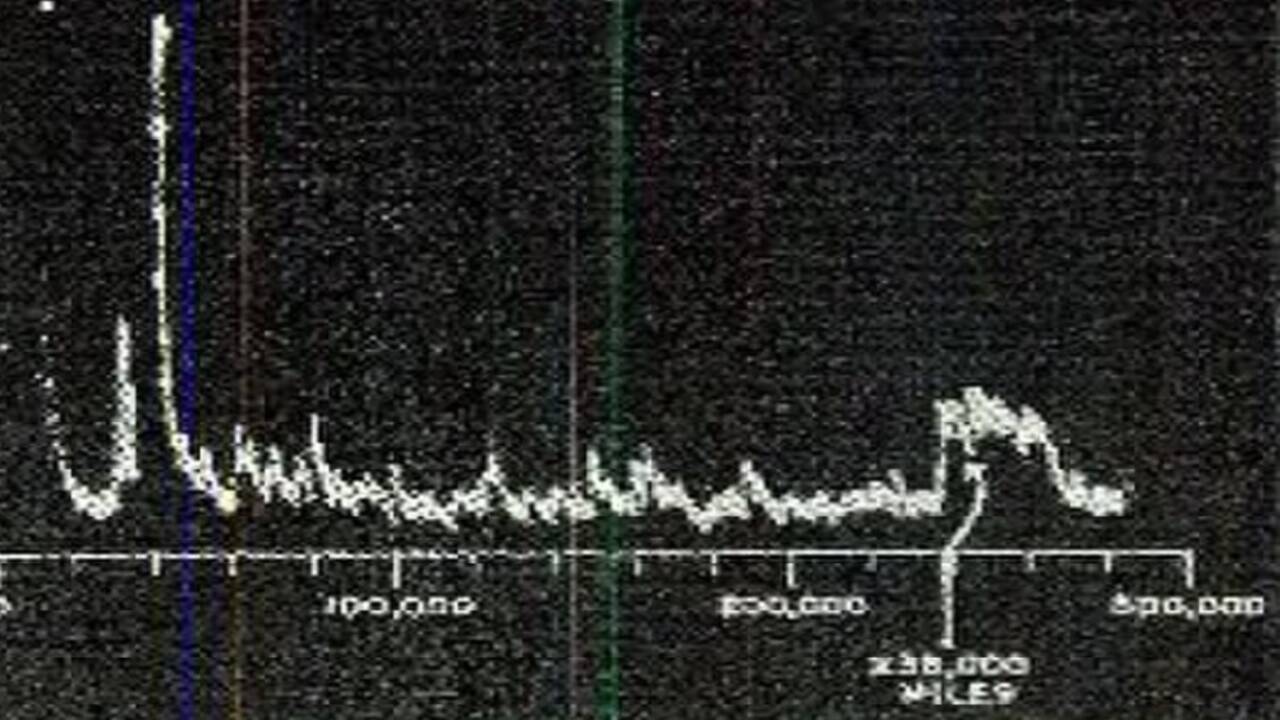
First radar return from the moon – Project Diana. Credit – Wikimedia Commons
Why Project Diana launched the modern space ageThe success of Project Diana gave researchers a practical way to use radar for measurements beyond Earth’s atmosphere. Later radar astronomy experiments built on this principle to study the distance, motion and physical properties of objects in the solar system.Its longer-term importance came from showing that ground-based radar could be used as an active tool for studying objects far beyond Earth’s atmosphere. The experiment showed that radar technology was not limited to detecting aircraft or objects within Earth’s atmosphere; it could also be used to reach across the enormous distance between Earth and the Moon and receive a measurable response. That achievement gave scientists and engineers an early practical demonstration that radio waves could serve as a tool for exploring space from the ground. By showing that a signal could be sent to the Moon and detected on Earth, those early engineers helped open the way for later satellite communications and lunar missions.


