
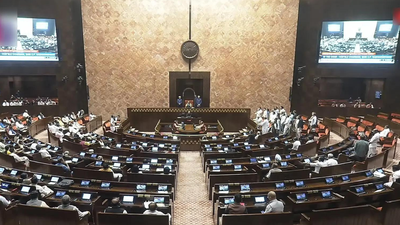
Members of Parliament and the political class occupy positions of immense responsibility. Their words influence public opinion, shape democratic culture, and leave a lasting impact on younger generations. In a vibrant democracy, political criticism is both legitimate and essential, but it must remain within the bounds of constitutional propriety and public decorum. Unfortunately, irresponsible statements, personal attacks, intimidation, and the mocking of constitutional authorities, institutions, and sections of society have increasingly become a part of political discourse merely to gain media attention or score political points. Such practices diminish the quality of democratic debate and weaken public confidence in institutions.Recently, Mr. Rahul Gandhi’s remarks generated serious concern within sections of the academic community, when he used a threatening tone while referring to a well known academician and Vice-Chancellor of the University of Delhi, who had merely advised students not to indulge and stay away from the abusive and unlawful conduct of the crowd protesting at Jantar Mantar. Mr. Rahul Gandhi remarked, “How dare you… Please note, you are the ones that will be held accountable when the time comes.” As the institutional Head of DU, VC was simply performing his duty.The academic fraternity found it as denigrating and unbecoming of a Leader of the Opposition. It reflects the sense of dynastic superiority and arrogance often associated with his politics. Earlier, in 2024, Mr. Rahul Gandhi had questioned the merit of Vice-Chancellors and allegedly described them all as “Sanghis”. In response to it, 181 Vice-Chancellors jointly defended the statutory appointment process prescribed under the UGC Regulations and emphasized the need to respect institutional procedures rather than making sweeping allegations.Similarly, Smt. Priyanka Gandhi Vadra, following the same political line as her brother, participated in the debate on the Public Examinations (Prevention of Unfair Means) Amendment Bill, 2026. During the debate, she referred to IIT Madras Director Prof. V. Kamakoti as a “Gaumutra” (Cow Urine) expert, discarding the fact that Prof. Kamakoti is a distinguished computer scientist and an accomplished academician who has made significant contributions to research, higher education, and technological innovation in India. Her remark was heavily criticized by thousands of people and more than 215 academicians came forward to publicly oppose it, describing it as derogatory towards a respected academic institution and one of India’s leading scientists. Such language neither strengthens parliamentary debate nor reflects the dignity expected from elected representatives.Likewise, some other Members of Parliament also appear to be adopting a style of politics driven by controversy and instant media attention. One such instance was witnessed on July 31, 2026, when Independent MP Pappu Yadav disguised himself as a Hindu Sadhu, wore saffron robes, and performed a satirical act inside the Parliament complex. Such an act is a mockery of Hindu priests, and insensitive to the religious sentiments of millions. Political protest must never come at the cost of ridiculing faith or hurting the sentiments of any community.Both Mr. Rahul Gandhi and Smt. Priyanka Gandhi continue to represent a political tradition frequently associated with family-centric politics and inherited leadership. Their public interventions often reflect this political approach rather than an institutional one. Many observers believe that such rhetoric overlooks the aspirations of a nation undergoing rapid transformation through educational, cultural, and developmental reforms. It is also observed that the intimidation and mocking of academicians and scientists by sections of the Congress ecosystem has increasingly become a disturbing pattern that deserves serious opposition. If such discourse becomes the dominant political language for the youth, its consequences could be damaging.A glimpse of this was visible during the recent protests over examination reforms at Jantar Mantar, where many young participants resorted to this model of abusive and uncivil language of their role models, reflecting a worrying decline in the standards of democratic debate. A serious issue affecting millions of students was reduced to partisan politics. Such developments underline the urgent need to protect young citizens from the ‘new-normal’ of abusive political rhetoric and the erosion of democratic civility.Political disagreement is the essence of parliamentary democracy, but disagreement should never come at the cost of institutional dignity or public civility. Universities, constitutional bodies, and public institutions deserve constructive criticism supported by evidence rather than rhetoric that undermines their credibility or erodes public trust. Democratic accountability is strengthened when criticism is informed, responsible, and respectful. These standards are not the responsibility of any one political party alone; they apply equally to every public representative, irrespective of ideological affiliation or political position. The conduct and language of elected representatives establish the standards of democratic behaviour for society, particularly for young citizens. India’s democracy will be strengthened not by intimidation, ridicule, or personal attacks, but by responsible leadership, reasoned debate, constitutional values, institutional integrity, and mutual respect.
Disclaimer: Views expressed above are the author’s own.


