
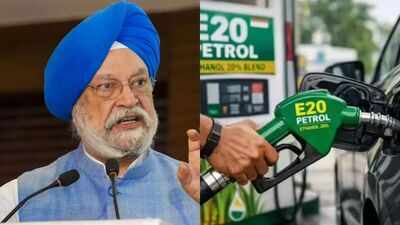
NEW DELHI: Petrol in Delhi would have cost around Rs 125 a litre when global crude prices touched $135 a barrel, had oil companies not blended ethanol into the fuel, the petroleum ministry said on Friday, defending the ethanol programme against claims about its costs, food security impact, and alleged taxpayer subsidy.The ministry said consumers instead paid Rs 94.77 per litre, since ethanol — procured domestically at pre-agreed prices — made up 20% of every litre and helped insulate retail prices from the crude spike, saving nearly Rs 30 a litre at the peak of the crisis.The government held petrol and diesel prices steady for nearly 75 days after the West Asia conflict began on February 28, before raising them by Rs 7.5 a litre in May. Standard E20 petrol (91-octane) now costs Rs 102.12 a litre in Delhi, while 100-octane petrol is priced at Rs 169.The ministry also denied allegations that foodgrain meant for the poor was being diverted for ethanol production, or that subsidised FCI rice was being used to support the programme.On the question of fuel efficiency, the road transport ministry — citing a study by ARAI, SIAM and IOC — told the Lok Sabha on Thursday that BS-III, BS-IV and BS-VI vehicles designed for E10 fuel may see efficiency drop by 2-6% depending on vehicle category and age when run on E20. The oil ministry had earlier told the Rajya Sabha on July 20 that the reduction in such vehicles is limited to about 3-5%.Both ministries said the Ethanol Blended Petrol programme was rolled out through a phased, scientifically validated process, with blending levels raised gradually as production capacity and infrastructure were built up. Road transport minister Nitin Gadkari told the Lok Sabha that the shift to E20 followed validation of fuel systems, engine durability, drivability, material compatibility and emissions performance, with automakers, oil marketing companies, and the sugar and grain industries consulted throughout.The government added that lab studies and real-world data have shown no adverse impact on vehicle performance from E20 fuel, noting that over 20 crore two-wheelers and 3 crore-plus petrol cars have run on these blends without verified evidence of engine failure linked to ethanol blending.


