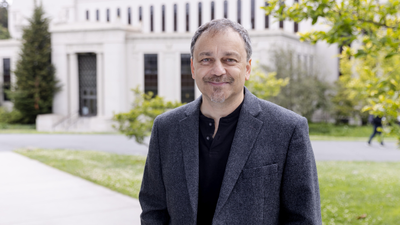
Munis D Faruqui, professor of South and Southeast Asian Studies at the University of California, Berkeley, has spent nearly three decades immersed in Mughal archives. The result is ‘Aurangzeb Alamgir and the Mughal Empire’, in which he argues for a nuanced reassessment of the most controversial and polarising figure in South Asian history. In an interview with fellow historian William Dalrymple, Faruqui discusses his complex legacyYour book draws extensively on the multi-volume Akhbarat — the Mughal court newsletters — which previous historians largely ignored. What did thirty years immersed in these documents reveal that simply could not be seen through the chronicles alone?Just to clarify, I have known about the Akhbarat for 30+ years, but I have not worked on them for as long. I first began to work with them in the late 2000s but that was for a previous book focused on Mughal princes, violence, and Mughal state formation. But truth be told, I did not know what to expect the first time I walked into the National Library of India (in Kolkata) to work on the collection. However, upon turning the very first page of the first volume, I realized what an extraordinary resource this collection was. Although the coverage for the first twenty years of Aurangzeb/Alamgir’s reign is relatively thin, from the early 1680s onward the Akhbarat become increasingly dense, with almost daily reports for some years. All told, there are tens of thousands of individual news items that cover around one-third of Aurangzeb/Alamgir’s reign. What makes the Akhbarat such a remarkable resource is their granular detail and vast coverage. No subject, or so it seems to me, is beyond covering. Another virtue of the Akhbarat is that they are barebones reports of events at and, sometimes, beyond the Mughal court. There is no obvious editorializing by the writer/scribe. They were simply meant to be read by the recipient (in this case the Raja of Jaipur) and then thrown away. At the end of the day, the Akhbarat are the exact opposite of a historical chronicle which is the result of careful editorial choices by its author. If something is not worth talking about or is a taboo subject in the mind of a chronicler, it will likely get little to no airtime in a historical account. Not true for the akhbarat. A good example of this disjunct is how little information is available to us about imperial eunuchs or the harem in Aurangzeb/Alamgir-era imperial chronicles. By contrast, the akhbarat are full of references to both. There are so many other potential akhbarat-linked storylines that never made it into my book but are waiting for others to uncover.Jadunath Sarkar’s biography, written a century ago, essentially set the terms for how Aurangzeb has been understood ever since — the pious zealot whose religious bigotry destroyed the empire. What is the single most important correction you want to make to that portrait?One of my big disagreements with Sarkar is around Aurangzeb’s underlying motives for turning to Islam-inspired measures to run the Mughal Empire. Where Sarkar saw a religious bigot who was trying to impose a theocratic Islamic order with the purpose of oppressing non-Muslims, I argue that Aurangzeb looked to Islam-inspired solutions to try and solve the empire’s many political, social and financial problems following his accession in 1658. He honestly believed that they would work to the benefit of all his subjects. How could they not, especially given their origin in God’s word? Unlike Sarkar, I also see a deeply pragmatic emperor. Even if he believed that Islam was the best religion of all and that being or becoming a Muslim was a blessing, he never tried to force his mostly non-Muslim subjects to convert to Islam. He understood that doing so would undermine the empire. Such pragmatism as well as continued adherence to most parts of the sovereign script of his predecessors are things that Sarkar overlooks in his efforts to tar Aurangzeb. Aurangzeb in middle age was regarded a gifted administrator, a pragmatic politician and a remarkable general. If he had died at, say, sixty, before the catastrophic Deccan overreach and the long decline into vengeful, increasingly impotent old age, how differently might history have remembered him? Could he have gone down as one of the greatest Mughals?The average life expectancy of the first five Mughal rulers was around fifty-eight years. By contrast Aurangzeb lived to eighty-eight. Had he lived to fifty-eight or even sixty, that is to 1676 or 1678, he would have undoubtedly been judged, deservedly so, as a great emperor. He would have been credited with a massive slew of early reign reforms, stabilizing Mughal finances, securing the empire’s boundaries, and containing rebellions by groups like the Jats, Satnamis, Sikhs and Afghans. He would have also avoided the historical judgements that lambast him for his decision to reimpose the jizya tax (1679), crush the Marwar- and Mewar-based rebellions (1679-1681), and – most of all – undertake the Deccan campaigns (1682-1707).In his own lifetime Aurangzeb was apparently revered by some as a living saint — a zinda pir — by Hindus and Muslims alike. How do we square that with his subsequent reputation, and when precisely did the transformation happen?That’s a great question. There were always those in his own lifetime who did not view him as a zinda pir or a pir-i dastgir (a guiding saint). But this seems to have been a minority view among the empire’s subjects. Aurangzeb’s reputation really began to take a hit in the decades after his death as various groups sought to establish their political and military bona fides as successors to the Mughals. In the case of the Marathas, Jats, Afghans, and Sikhs (to name a few), opposition to Aurangzeb became a way of highlighting individual group strength and offering claims to power against other regional rivals. After all, if they had managed to successfully fight against the great and mighty Aurangzeb, weren’t they also great and mighty and therefore worthy successors? One of the key moments in this exercise was a reinterpretation of the Rajput wars of 1679-1681 to make it seem like most Rajputs rose up against Aurangzeb/Alamgir when in fact the vast majority continued to support the empire against one faction within Marwar (led by Durga Das Rathor) and Mewar. The upshot of all of these maneuvers was this: Aurangzeb was increasingly seen as a Sunni-Muslim bigot whose religious intolerance forced non-Muslims to rise up in rebellion to protect themselves and their religion. The transformation that you talk about began in the years immediately following his death, as the empire began to fall apart, and was mostly complete by the latter half of the eighteenth century. By the mid-18th century, British historians were already encountering stories of Aurangzeb’s temple destruction, and within a century virtually every destroyed temple in India had become associated with him — even those clearly destroyed by earlier sultanates. If he only destroyed a limited number, how did the legend of Aurangzeb the great temple destroyer become so rapidly and firmly fixed in tradition? In the specific case of Aurangzeb’s reputation as a temple-destroying iconoclast, I think the seminal moment here is when the Mughals invade the state of Mewar in the early 1680s because of their support for the Marwar-based rebel Durga Das Rathor. In the scorched earth campaign that follows, one of the things the Mughals and their Rajput allies did was target temples connected to the royal family of Mewar as a way of delegitimizing them and forcing them to the negotiating table. Although the Mughals succeeded in their war goals, Mewar was ultimately handed a potent storyline of standing up to Aurangzeb of fighting for and suffering to protect Hindu dharma. They deployed this legend in the eighteenth century against rival Rajput states as well as the Marathas (who had their own stories of temple destruction to draw on). What follows is an arms-race of claims over the following centuries and across the Indian subcontinent to being victims of Aurangzeb’s iconoclasm. The beauty of this claim is that it is easy to make and, more importantly, it is believable – even if it ultimately is barely true.Audrey Truschke’s recent reassessment, very controversial in India, was broadly sympathetic to Aurangzeb- perhaps more so than yours. Where do you agree with her conclusions, and where do you fundamentally part company?I think Audrey Truschke’s work opened the door to a long overdue reassessment of Aurangzeb. Although I was already working on my own book when hers got published in 2017, I immediately recognized that it was an important, maybe even necessary forerunner which might make some of my own arguments seem less bizarre and “out there.” Her most important intervention was the simple plea to judge Aurangzeb/Alamgir in the context of his times and on his own terms, not according to modern values. Doing so, she correctly argued, would allow us to hopefully move beyond a world of simple stereotypes such as “Aurangzeb the Bigot” or “Aurangzeb the Pious.” In terms of parting company with Audrey Truschke, I don’t have any major disagreements but lots of minor quibbles. Here’s one example: I do not think that Aurangzeb/Alamgir imposed the jizya to basically suck up to the Muslim ulama. I think he did so for financial reasons and believing that some non-Muslim communities were getting richer thanks to favorable conditions offered by the empire but not paying their fair share of taxes. I also think she does not give enough credit to Jadunath Sarkar for writing the first serious and modern account of the emperor. Although I disagree with some of Sarkar’s major interpretations, his work was groundbreaking and even generative for subsequent generations of Mughal historians, including me.The book is ultimately a study in profound failure. Aurangzeb began as a talented general and administrator and ended having fatally overstretched the empire in the Deccan. Was this strategic hubris, ideological rigidity, or something more personal and tragic?To understand his fixation with the Deccan, you have to understand that its conquest was a longstanding Mughal obsession going back to the last decades of Emperor Akbar’s reign in the 1590s. Aurangzeb was just the latest Mughal emperor attempting to complete a process begun by his great-grandfather, who he revered deeply. In Aurangzeb’s case, however, his efforts came with a special and deeply personal angle. Two stints as a princely governor, between 1636 and 1644 and then again between 1652 and 1657, led him to believe that he knew the region better than almost anyone else at the Mughal court. This belief played itself out repeatedly between his accession in 1658 and 1682, when he finally took direct charge of Mughal forces in the region. Put differently, Aurangzeb was fixated on the Deccan long before he moved down on a permanent basis. Could he have foreseen what turned out to be a military quagmire? Absolutely not. As late as 1690, he was riding high following the conquests of Bijapur and Golkonda, the execution of Sambhaji, and successful military expeditions into peninsular India. At the time some of his closest advisors were begging him to declare victory and return to northern India. He could have done so but decided against it. As a consequence of this ill-fated decision, as things unraveled for complicated political and military reasons, he felt a deep personal responsibility to correct a situation of his own making. Failure to do so, he thought, would render him politically vulnerable and embolden myriad opponents who were waiting for the opportunity to strike against him. But there is another part to this story: having achieved great success in the 1680s, he believed almost to the end to his life that success was well within his grasp if he tried just a little harder, undertook one final push. Of course, as we now know, this was a fool’s errand. Unfortunately, lots of people suffered terribly for the emperor’s stubborn obsessiveness.His deathbed letters reveal an extraordinary sense of having been abandoned by God. What do those letters tell us about how he understood his own reign?You are right that the deathbed letters highlight his sense of having been abandoned by God. They also suggest that he feared that his family, the nobility, and the empire would tear themselves apart after his death. All in all, I think he looked back on his reign as a colossal failure. Although he never says this, I would not be surprised if he believed that the empire was weaker on the eve of his death compared to when he ascended the Mughal throne in 1658.You argue that his treatment of Hindu subjects was largely pragmatic rather than ideological, and no different in kind from his predecessors. Can you briefly make the case, because for many readers in India today, that will be the most contested claim in the entire book.This is a really complex question and one that is best answered by reading my book versus me trying to make a brief case here. This being said, let me try and take what will almost certainly be an unsatisfying stab at it. To begin with I think it is really important to acknowledge that Aurangzeb was a deeply religious man whose personal life was intimately shaped by his religious beliefs. Take his decision to memorize the Quran, starting at the age of forty-three. It took him seven years to accomplish. He was the only major Mughal emperor to ever memorize the Quran. Such religiosity caused him to act in other ways that marked him off from predecessors like Akbar, Jahangir, and Shah Jahan. For instance, he gradually removed himself from participating in ceremonies like jharoka darshan and wazn/tuladan. But the interesting thing here is that he continued to encourage his heirs to undertake both because of their close association with a larger Mughal imperial script. Across his long reign, we see a myriad other examples of such pragmatism. Did Aurangzeb have preferences, and might he have wished to wave a magic wand to force everyone to do things exactly the way he wanted? Yes, no doubt! But he also knew better than almost anyone else that he did not live in a perfect world of his own making. He was too pragmatic and understanding of how power worked in the Mughal Empire to do anything that might undermine the big tent that was the Mughal polity. At the end of the day, it seems clear to me, Aurangzeb was primarily interested in four things: ensuring elite loyalty, collecting taxes, maintaining social hierarchies, and expanding the empire. Anything that might interfere with these goals was to be avoided. In this regard, he was exactly like his predecessors. What do you make of Dara Shukoh and do you think he actually deserves his very positive reputation in India today?Dara Shukoh was an extraordinarily interesting person. One cannot but marvel at his intellectual journey from the early 1630s and his initial interest in Qadiri Sufism to his final resting point in 1657 where he was arguing that the Upanishads were the world’s original monotheistic text. By virtue of this fact, the Upanishads could – in his opinion – explicate on mysteries in the Quran, clarify Islam itself, and provide unique insights into the “boundless ocean” that is Divine Oneness. Whatever we might say about Dara Shukoh’s findings, it is worth noting that his project was different from Akbar’s. Where there is a genuine interest in Vedic Hinduism in Akbar, there seems to be an instrumental quality to Dara Shukoh’s interests. He was out to prove that he was a man of rare spiritual insight and intelligence who had been specifically blessed by God to reveal monotheism’s greatest and long held secrets. So, even if he was largely bereft of military or administrative skills (unlike his brother Prince Aurangzeb), he was convinced that he brought certain spiritual qualities that were unequalled in the entire history of the Mughal and Timurid royal families. In making such a grandiose argument, I believe he was making a case for why he deserved to follow his father Shah Jahan as the next emperor versus any of his brothers. In India he is revered for two main reasons: seemingly extending Akbar’s humanistic religious projects and offering a counter-vision to Aurangzeb’s Islamic orthodoxy. I do not believe Dara Shukoh was doing either. I also do not believe that the accession of Dara Shukoh would have saved the Mughal Empire from collapse. Indeed, under his control, the empire may have collapsed even earlier than it did. But this is not to say that Dara Shukoh’s positive reputation is undeserved. It’s just that there is a disjunct between what he was doing in his own lifetime and what people remember and revere about him today.Aurangzeb’s reputation in Pakistan is strikingly different from his image in India — revered rather than vilified, a symbol of Islamic piety rather than Mughal overreach. What does that divergence tell us about how the same historical figure can be made to carry entirely opposite political and religious meanings?It is worth noting that Aurangzeb’s reputation in Pakistan actually is quite complicated. Whereas Pakistani state organs, the publicly funded educational system, the political and military establishments and their religious allies, and the mainstream media amplify narratives of him as a great Muslim hero who tried to save Islam from being overwhelmed by Hinduism, groups opposed to the Pakistani state or its post-1970s Islamization project – including secular Pakistanis, Sufis, Shi‘ites, feminists, and Pathan and Sindhi nationalists (to name a few) – lambast Aurangzeb/Alamgir whenever the opportunity presents itself. This divergence in opinions in Pakistan highlights how the politics of the here and now can sometimes reach back in time to find heroes or villains to tell self-serving or self-reinforcing stories. What happened in India post-1947 was not so different. Traumatized by Partition, desperate to understand why it happened, and determined to pursue a secular state-building project, Aurangzeb/Alamgir became a convenient whipping boy. The fact that the Pakistani state embraced him as one of nation’s historic “founders” did not help his reputation in India. Aurangzeb has become a potent and highly charged symbol, invoked constantly in debates about Hindu-Muslim relations and the Mughal legacy. Does that contemporary politicisation make it harder or easier to write honestly about him — and did you feel any responsibility to the present moment in how you told this story?I was repeatedly advised by faculty friends over the years to work on any period other than the late seventeenth century and anyone other than Aurangzeb. Many feared that I was opening myself to personal disparagement at best, physical violence at worst. My response has been to try and tell my story in as dispassionate a way as I possibly can and, more importantly, to let my archives guide me in whatever direction they take me. In truth, if I had, found lots of instances of forced or mass conversion at the Mughal court, I would have detailed it. Likewise, if I had found lots of instances of attacks on Muslim-minority or non-Muslim communities for persecutory religious reasons, I would have included them in the book. The reality is that I did not. That this book is coming out in a time of charged politics is most unfortunate. But there is nothing that I can do about that. I just hope that people will take the time to read my book and be open-minded enough to learn from it versus simply dismissing it because they don’t like Aurangzeb or think that my scholarship is compromised because of assumptions about my religious and/or national background.In recent years, the Mughal dynasty has been substantially removed from the Indian school curriculum. As a scholar who has devoted thirty years to recovering the full complexity of Aurangzeb’s reign from primary sources, what would you say to the culture ministry about that decision? What arguments would you marshall to persuade them to reverse it?I would simply ask the Ministry of Culture to read an April 19, 2026, piece titled “What have the Mughals ever done for us?” in the Economist. Penned by Banyan, their India-based correspondent, the piece argues that the Mughals’ achievements are “Indian achievements.” It goes on to highlight the dynasty’s influence on language, food, music, architecture, art, dress, and syncretism, among other things. I would also offer two quotes. The first is by Winston Churchill: “A nation that forgets its past has no future.” The other by Maya Angelou goes as follows: “History, despite its wrenching pain, cannot be unlived, but if faced with courage, need not be lived again.” Which is your favourite Mughal? If you were able to invite a few of them to a fantasy dinner with you in Berkeley who would you choose?My favorite Mughal is probably Babur, the founder of the Mughal dynasty. Although he is reviled in contemporary Hindu nationalist circles as a foreign invader and Muslim iconoclast, he in fact was very well educated, highly cultured, the author of a fantastic autobiography, a man of great sensitivity and curiosity, a loving son, brother and father, a loyal friend, a survivor, a gifted raconteur, a man of few airs and graces, and a pleasure seeker, among many other things. How could one go wrong with someone like Babur? Offer him a few kababs and lots of wine and you’d be off to the races. Whatever I’d do, I would avoid inviting Aurangzeb because I suspect he’d disapprove of the wine fueled merriment that would undoubtedly unfold around Babur.This interview reflects the views and interpretations of historian Munis D. Faruqui, based on his research


